Finish Festival Henna in Under 30 Minutes: Designs, Timing, Aftercare
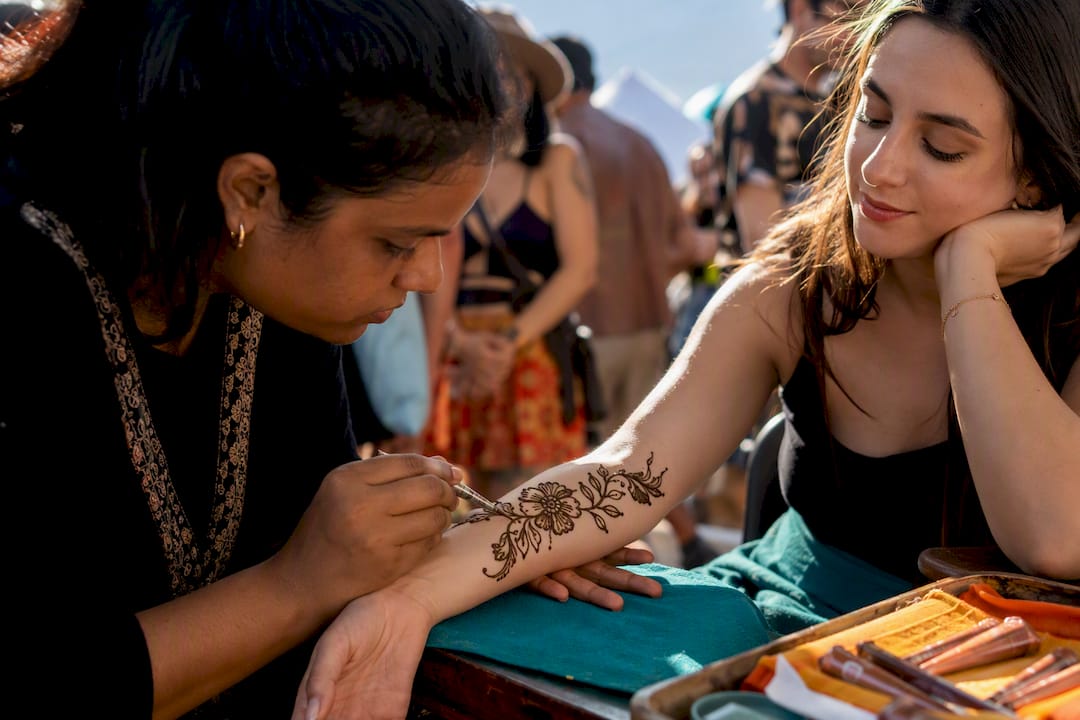
Pick a design you can finish in under 30 minutes, patch test it two days out, and leave the paste on as long as your festival schedule allows. That combination, quick festival-friendly design plus a real patch test plus proper aftercare, is what separates henna that photographs beautifully on day three from henna that flakes off by lunch.
TL;DR:
Choosing a simple, quick design like Arabic floral trails or minimalist finger art ensures a clean, photo-ready henna look in 15 to 30 minutes, suitable for festival timing.
Patch testing 24 to 48 hours before the event minimizes allergy risks, while exfoliating skin two days ahead improves stain depth and evenness.
Proper aftercare, including leaving the paste on as long as possible and sealing with lemon-sugar or oil, significantly deepens and prolongs the stain.
Avoiding “black henna” with PPD and asking for ingredient transparency prevents allergic reactions and skin damage from unsafe chemicals.
Applying with hover-and-flow technique and selecting thicker-skinned areas like palms or soles maximizes stain darkness and longevity.
Table of Contents
Henna for Festivals: Finding the Right Design for Your Time and Outfit
What Actually Makes Festival Henna Look Sharp and Last Longer
Staying Safe: Allergies, Black Henna, and Respecting the Tradition
A Quick Checklist for Smooth Festival Henna, Whether You’re Getting It or Giving It
Tips for Removing Henna if You Need to Before the Festival Ends
Henna for Festivals: Finding the Right Design for Your Time and Outfit
Festival henna lives or dies on timing. You are not sitting in a quiet studio for two hours. You are standing in line, sweating a little, maybe holding a drink, and you need a design that a skilled artist can finish before your friends wander off without you. The good news: some of the most striking festival looks are also the fastest to apply.
Arabic floral trails are the workhorse of festival henna. Long, flowing vines with leaf clusters and the occasional flower burst run up the wrist, forearm, or foot, and they read as bold and detailed in photos even though they only take 15 to 30 minutes for an experienced artist. The open space between the vine work is part of the design, not a shortcut, which is exactly why it looks intentional rather than rushed. Ask for a trail that runs along your forearm or up the side of your foot if you want something that shows well in festival photos taken from a distance.
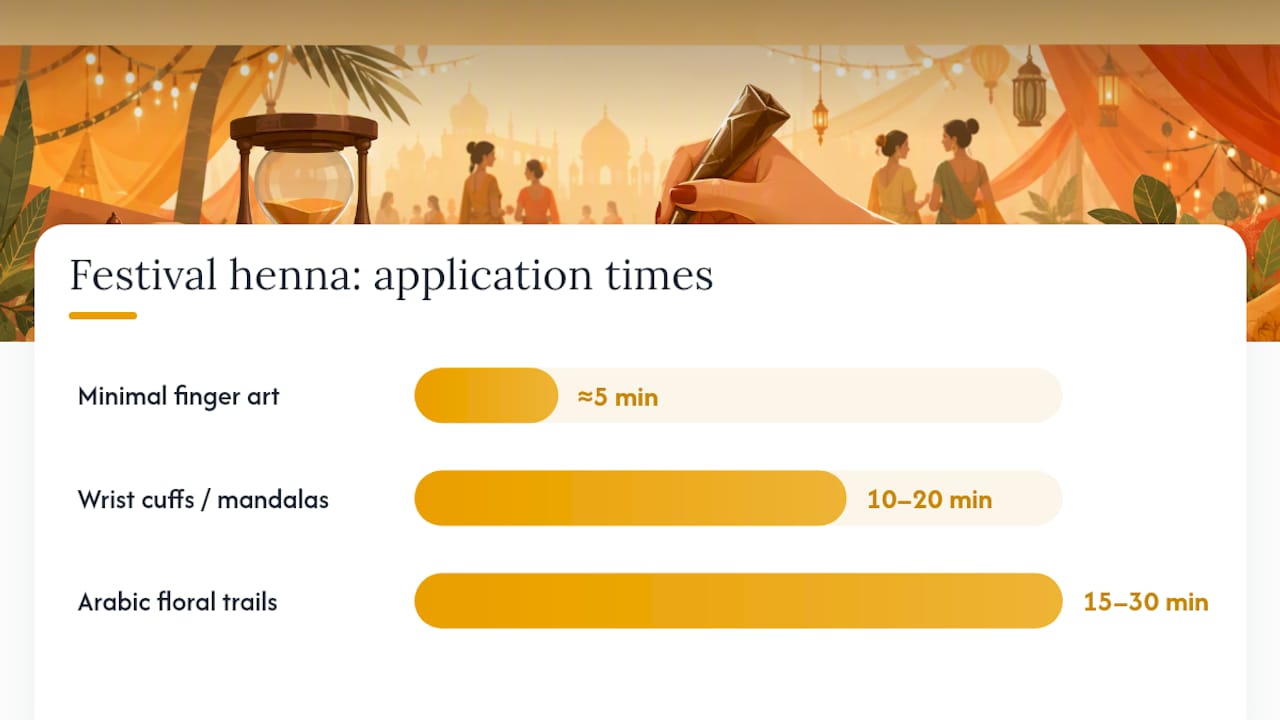
Minimalist finger art is the move when you have five minutes and a friend who is already three songs into the headliner’s set. A single band around one finger, a tiny sun or moon on a knuckle, or a delicate dot pattern along the side of the hand takes almost no time and still reads as intentional body art rather than an afterthought. According to recent festival henna trend coverage, minimalist finger and hand accents have become one of the dominant looks for outdoor events, partly because they pair with any outfit and partly because they simply survive better under festival conditions than dense full-hand coverage.
Wrist cuffs sit in the middle: more visual weight than finger art, less commitment than a full sleeve. A cuff design wraps the wrist like a bracelet, usually with a repeating geometric or floral motif, and gives you a focal point for wrist shots without covering your whole hand. Mandalas, whether centered on the palm or the back of the hand, do something similar but with more symmetry and more built-in “wow” for a close-up photo. Both styles typically run 10 to 20 minutes depending on how much detail you request.
If you want something festival-goers notice from a few feet away, look at ankle and foot accents or a shoulder crown. Anklet-style bands with small charms or vine details work well with festival sandals and shorter hemlines, and they tend to survive sweat and dust better than hand designs because there’s less friction from touching things all day. A shoulder crown, a radiating design that sits at the top of the shoulder and spills slightly down the arm, pairs naturally with off-shoulder tops and tank dresses, which is a big part of why it shows up so often on festival inspiration boards. Browsing a festival henna idea board is a fast way to see how these placements actually look on real bodies before you commit.
Here’s a quick reference for matching style to your time budget:
5 to 10 minutes: single-finger bands, small wrist dots, tiny ankle charms
10 to 20 minutes: wrist cuffs, small mandalas, simple foot accents
15 to 30 minutes: Arabic floral trails, shoulder crowns, larger mandalas
30+ minutes: full-hand designs, matching group patterns, detailed sleeve work
Group photos deserve their own strategy. Matching or coordinated motifs, the same small symbol repeated on everyone’s wrist, or a shared color accent worked into each person’s design, make festival photos look planned even when the whole group got henna in a rushed 40-minute window. Some artists keep a small template book specifically for this, letting a group pick one base motif and then vary the placement so each design feels personal without eating extra time. If you’re the one doing the applying rather than receiving it, a set of reusable DIY henna stencils makes matching group designs dramatically faster and more consistent than freehanding six similar patterns back to back.
One placement note worth remembering: darker, longer-lasting stains tend to happen on thicker-skinned areas like palms, soles, and the tops of feet. If you care more about stain depth than initial line detail, lean toward those spots. If you care more about intricate visual detail for photos, the back of the hand and forearm give an artist more room to work with finer lines.
How to Prepare for Henna at a Festival
Preparation for festival henna is mostly about timing three things correctly: your patch test, your skin, and your schedule. Skip any one of them and you either risk a reaction or end up with a stain that fades before the festival ends.
1. Patch test 24 to 48 hours before the festival. Apply a small dot of the henna paste, or ask your artist for a sample dot, on the inside of your forearm or behind your ear. Leave it undisturbed for the full window, then check for redness, itching, swelling, or blistering. No reaction means you’re clear to proceed. Any reaction, even mild, means you should skip henna from that batch entirely and ask about the ingredients. For a full walkthrough of how to run this correctly, Hennaforfun’s henna allergy patch test guide covers the exact steps and what different reaction types mean.
2. Prep your skin two to three days out. Gently exfoliate the area where you plan to get henna to remove dead skin cells; this helps the stain take evenly instead of looking patchy in spots. Stop using body lotion or oil on that skin at least 12 hours before your appointment, since oil creates a barrier that keeps the paste from bonding well. Dry, clean, lightly exfoliated skin gives you the best base for a dark, even stain.
3. Time your appointment around your festival schedule, not just your arrival time. For a single-day festival, get henna as early as you comfortably can, ideally right when gates open, so the paste has hours to sit before you need clean hands for food, drinks, and photos. For multi-day festivals, the smart move is getting henna applied the evening before a day you plan to spend mostly out of the water and sun, since the stain darkens over the following 24 to 48 hours regardless of what you’re doing.
4. Bring the right things to the booth. A few small items make the whole process smoother for you and the artist working on you.
Here’s a simple checklist:
A photo or two of designs you like, saved on your phone
A rubber band or hair tie if the design is anywhere near your wrist and you tend to fidget
A phone charger or portable battery, since you’ll want your hands still and free for a while
Snacks or water pre opened, since you can’t easily hold a bottle right after application
A light jacket or wrap if the design goes near your arms and evenings run cool
Pro Tip: If you’re getting henna on your hands, wear slip on shoes and skip anything that needs buttons or zippers for the next hour. You will regret every button.
What Actually Makes Festival Henna Look Sharp and Last Longer
The technique an artist uses matters as much as the design you choose, and it’s one of the easiest things to evaluate in the moment if you know what to look for.
The biggest difference is between hover-and-flow application and dragging the cone. In hover-and-flow, the artist keeps the cone tip slightly raised above the skin so the paste drops down and pools into a small raised line, rather than being pressed and dragged along the surface. According to application technique guides, this raised bead of paste matters because it gives the dye more contact time and more paste volume sitting directly on the skin, which produces a deeper, more even stain than a thin dragged line. You can actually see the difference while it’s happening: hover-and-flow lines look slightly raised and rounded, while dragged lines look flatter and thinner.
Paste quality is the other half of the equation, and this is where you need to pay attention for safety reasons, not just aesthetics.
Natural henna paste is typically a deep brown or olive green color when wet and smells earthy, like dried leaves or tea.
It stains skin orange to reddish brown, deepening to a darker brown over 24 to 48 hours.
“Black henna” that promises an instant jet black stain almost always contains para-phenylenediamine (PPD), an additive not meant for prolonged skin contact.
If an artist can’t tell you what’s in their paste, or the paste is jet black straight out of the cone, treat that as a reason to walk away.
If you’re on a tight schedule, it’s completely fine to ask an artist for a “festival quick” version of a design you like. Most experienced artists can look at a detailed reference photo and simplify it, keeping the overall shape and feel while dropping some of the fine interior linework, in a fraction of the time. The polite way to ask is simple: “I love this design, but I only have about 10 minutes. Can you do a simpler version?” Good artists do this constantly and would rather adjust than rush the full design and produce sloppy lines.
Jagua is a separate plant-based dye, blue black rather than henna’s reddish brown, and some festival booths offer it as an accent alongside henna. It lasts about as long as henna but gives a completely different color family, so it works well for outlining or accenting a henna design if you want contrast. Glitter accents, either pressed into wet henna paste or applied over a finished dry design, add sparkle for photos but wash off within a day or two, so think of them as a same-day enhancement rather than something that lasts the whole festival.
Aftercare That Actually Deepens the Stain
What you do in the hours after your henna is applied determines whether you end up with a rich, dark stain or a light, disappointing smudge by the second day.
1. Leave the paste on as long as you can stand it. Longer contact time means more dye transfer. Overnight, six to eight hours, gives the richest result, but festival reality often doesn’t allow that. If you can manage even two to three hours before you need your hands free, you’ll still get a noticeably better stain than if you scrape it off after twenty minutes. Hennaforfun’s guide on how long to leave henna on skin breaks down the exact tradeoffs by time window if you want more detail than a festival schedule allows here.
2. Seal it with a lemon-sugar mix if you have access to one. A mix of lemon juice and sugar dabbed lightly over the drying paste helps it stay put and adds a bit of moisture that supports better dye release. At a festival, this isn’t always practical, so a reasonable alternative is dabbing on a small amount of coconut oil or Vaseline once the paste has fully dried and started flaking, which helps seal in what has already transferred.
3. When the paste flakes off, don’t wash the area right away. Scrape or brush off dried flakes gently rather than rinsing under water. Water contact within the first few hours can wash away paste that hasn’t fully transferred its color yet.
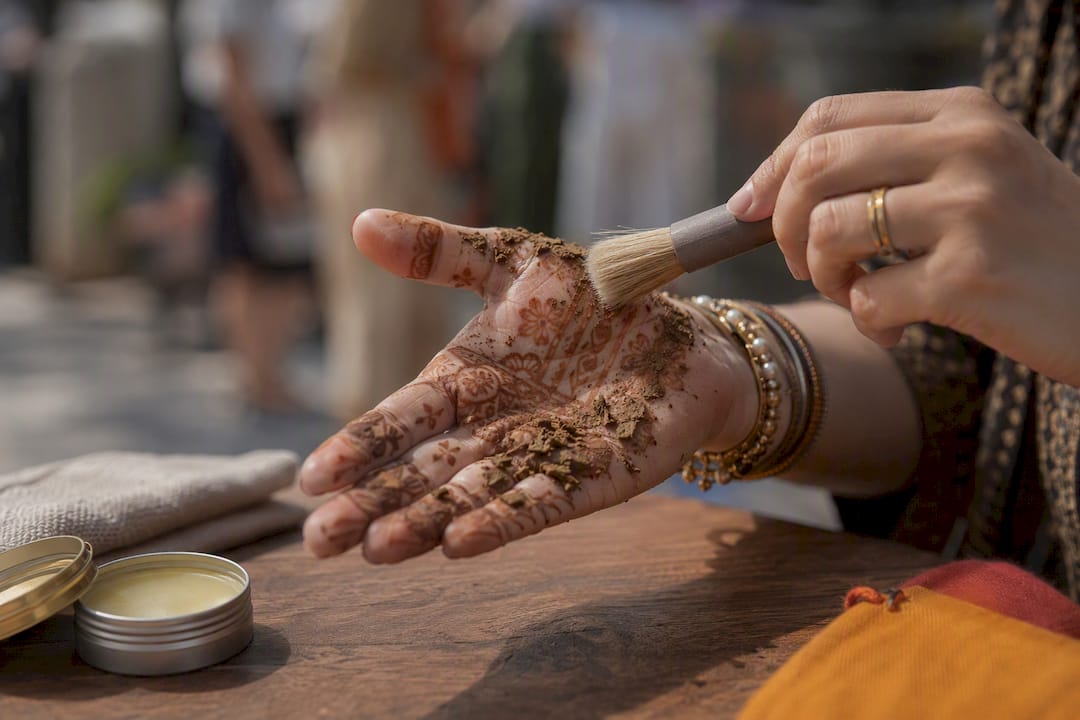
4. Avoid swimming, hot tubs, and heavy hand washing for the first 24 hours. Chlorinated water and repeated soap exposure both accelerate fading. If your festival involves a lake, a splash pad, or a lot of hand sanitizers between food vendors, plan your henna timing around those activities rather than the other way around.
Pro Tip: If sanitizer stations are everywhere at your festival, keep a small tin of balm or oil in your bag and reapply it after every hand sanitizing. It only takes a few seconds and meaningfully slows fading.
For readers who want the full color-maximizing routine beyond festival-day basics, the deeper guide to making henna stains darker covers longer-term tricks like essential oil reapplication over several days.
Staying Safe: Allergies, Black Henna, and Respecting the Tradition
The single most important safety issue in festival henna is telling natural henna apart from so-called “black henna.” Natural henna paste stains skin in shades of orange, red, and brown, and it takes a day or two to reach its darkest color. Anything promising an instant, jet-black stain almost certainly contains PPD, a chemical dye additive that can cause severe allergic reactions, chemical burns, and permanent scarring in sensitive individuals, sometimes not on first contact but on a repeat exposure.
Watch for these warning signs at a festival booth:
A booth offering “black henna” or promising an instant dark stain within minutes
An artist who can’t or won’t tell you what’s in the paste
No willingness to let you patch test or see a small sample first
Visibly rushed, sloppy application with no attention to line quality
Paste that smells strongly chemical rather than earthy or herbal
Natural henna is widely available and legal to use in the United States; there’s no ban on the plant itself. What’s actually risky, and what regulators have flagged, are PPD additives sometimes mixed into paste marketed as “black henna” to create a darker, faster result. Hennaforfun’s overview of henna safety and application rules goes into more detail on ingredient transparency if you want to vet a booth before sitting down.
Henna also carries real cultural weight worth acknowledging, even in a festival setting. It has played a role in weddings, religious festivals, and rite-of-passage celebrations across South Asian, Middle Eastern, and North African traditions for centuries, as Getty’s overview of decorative body art documents. Bridal patterns and certain sacred motifs carry specific meaning in those traditions. It’s reasonable, and appreciated by most artists, to simply ask, “Does this design have specific cultural or religious meaning I should know about?” before you get it. Most festival-style florals and geometric patterns are decorative rather than ceremonial, but a good artist will tell you when something isn’t.
A Quick Checklist for Smooth Festival Henna, Whether You’re Getting It or Giving It
If you’re running a booth, or even just doing henna casually for friends at a festival, a few logistics decisions make the difference between a smooth afternoon and constant backlog.
A visible design menu with clear time estimates and pricing keeps lines moving — see our detailed Family Session FAQ » Robinson Creative Newborn & Family Photography for tips on effective event photography session logistics. When people can see upfront that a finger accent takes five minutes and costs less than a full sleeve, they self-select into the right choice instead of asking the artist to negotiate on the spot. Posting three or four tiers, quick, standard, and detailed, with rough time and price next to each, cuts decision time dramatically.
Supply-wise, a few essentials matter more than people expect:
Extra pre-rolled cones, since one running dry mid-line is the fastest way to ruin a design and lose ten minutes
A small cooler or insulated bag to keep paste from getting too warm and runny in direct sun
Tape or a small clip to keep loose clothing or hair away from wet paste
A folding chair or stool at the right height for both artist and client, since hunched-over application for hours wrecks your back and your line quality
A simple card reader or payment app, since cash lines slow everything down
A small clip-on light for evening or tent sets, since natural light disappears fast after sunset
Time management comes down to honest, upfront communication. If someone wants a design that will clearly take 25 minutes and they mention they need to leave in ten, the kindest and most professional response is offering a simpler version rather than rushing the original and delivering sloppy work. A script like “I can do the full design in about 25 minutes, or I can do a simplified version of it in 8 to 10 if you’re tight on time” respects both the client’s schedule and the artist’s craft.
Weather deserves real planning too. Wind can lift paper stencils and dry paste faster than expected, which sometimes helps and sometimes hurts depending on humidity. Direct sun overheats paste and makes it harder to control, so booths under partial shade tend to produce better, more consistent work than ones baking in full sun all day.
Why Henna For Fun Understands Festival Henna Differently
Most festival henna advice comes from generic beauty blogs that have never actually staffed a booth during a three-day outdoor event. Hennaforfun built its approach around real events, including Whenna Events hosted at wineries and private homes where the same timing pressures apply: guests want striking designs without eating half the afternoon.
That event-first experience shapes what gets recommended here. The design-time estimates throughout this guide, the “festival quick” negotiation script, the emphasis on hover-and-flow technique, all come from patterns that hold up across repeated live events, not a single studio session. Private henna lessons are available for people who want to learn the craft themselves, whether for personal use, gifting, or eventually working festivals and events.
For readers planning ahead, the calendar of upcoming events shows where Hennaforfun shows up next, and the private lessons page covers what’s taught in a session, from paste handling to the same technique fundamentals covered in this guide. Together, those resources reflect a business built specifically around getting henna right in real-world, time-pressured settings, exactly the environment a festival creates.
Tips for Removing Henna if You Need to Before the Festival Ends
Sometimes you need henna gone faster than nature intends, maybe a design didn’t turn out how you wanted, or work requires clean hands sooner than expected. A few methods speed up fading without harming skin.
Exfoliation is the most reliable option. A gentle scrub with sugar and olive oil, or a regular body scrub, physically lifts stained surface skin cells faster than they’d shed naturally. Repeat once or twice a day and you’ll see noticeable lightening within a couple of days.
Warm water and soap, applied repeatedly, gradually strips color, though it’s slower than exfoliation on its own. Combining the two, a warm soapy soak followed by gentle scrubbing, works faster than either alone.
Hydrogen peroxide dabbed lightly on the stain can lighten it, but use this cautiously and only on small areas, since it can irritate sensitive skin. Always test on a small patch first.
What doesn’t work well: harsh scrubbing with rough tools, which can irritate skin without meaningfully speeding removal, and bleach, which should never touch skin directly. Patience combined with regular gentle exfoliation remains the safest approach. Most festival henna fades naturally within one to three weeks regardless of removal effort, so full removal usually isn’t necessary unless there’s a specific reason for it.
The Honest Take on Festival Henna
Most festival henna advice online focuses entirely on picking a pretty design and skips the logistics that actually determine whether it looks good three days later. That’s backwards. A gorgeous mandala applied with a dragged, thin line and zero aftercare plan will look worse by day two than a simple wrist cuff done with proper hover-and-flow technique and even ten minutes of paste time.
The conventional wisdom oversells design complexity and undersells timing. What actually matters, in order, is: a real patch test, an artist who uses proper technique, and a realistic plan for keeping paste on your skin as long as your schedule allows. Everything else, glitter, jagua accents, matching group motifs, is decoration on top of that foundation, not a substitute for it.
If you take one thing from this guide, let it be this: plan your henna around when you can protect it, not just when you have free time in line.
— Angana
Ready for Festival-Ready Henna? Here’s Where to Start
Reading about hover-and-flow technique is one thing. Getting it done right, or learning to do it yourself, is another. Hennaforfun offers exactly what this guide has been building toward: real festival-tested experience instead of generic beauty-blog advice.
If you want a professional artist who already understands festival timing pressure, book Hennaforfun for your event or festival booth. If you’d rather learn the technique yourself, private henna lessons walk you through paste handling and line control in a single session. And if you just need reliable supplies for a group, a handmade henna cone or a set of DIY stencils gets you festival-ready without waiting on a booking. Expecting parents planning a festival-adjacent celebration can also explore pregnancy henna designs built around the same quick, photo-ready philosophy covered here.
Practical next steps:
Book a Whenna Event or festival booth slot through the services page
Reserve a private lesson to learn hover-and-flow technique firsthand
Order cones or stencils ahead of your next festival weekend
Sources
This guide draws on Getty’s research into decorative body art traditions, an academic overview of body art diffusion, and application technique documentation covering the hover-and-flow method. For deeper how-to detail, see Hennaforfun’s guides on patch testing safely and maximizing stain darkness.
FAQ
Is It Culturally Insensitive to Get Henna at a Festival?
Wearing henna generally isn’t considered insensitive, since the practice has spread widely as decorative body art across many cultures for centuries. It’s worth asking your artist if a specific design carries religious or ceremonial meaning, since bridal and sacred motifs deserve more thought than generic florals.
Why Do People Think Henna Is Illegal in the U.S.?
Natural henna itself is legal and widely available in the United States. The confusion usually comes from “black henna” products containing PPD, a chemical additive that regulators have flagged as unsafe for skin contact, not from natural henna being banned.
Is It Okay for Christians to Get Henna?
Henna is a decorative body art tradition rather than a religious practice tied to one faith, so most Christian traditions have no specific prohibition against it. If you have denomination-specific concerns, discussing them with your own religious community is more reliable than general guidance.
How Much Does Henna Cost at a Party or Festival?
Pricing varies widely by design complexity and artist, with simple finger or wrist accents typically costing less than detailed full-hand or sleeve work. Festival booths often post tiered pricing based on design size and time, which is worth checking before you sit down.
Recommended
Comments