Party Ready Christmas Henna: 4 Quick Tutorials and Festive Motifs
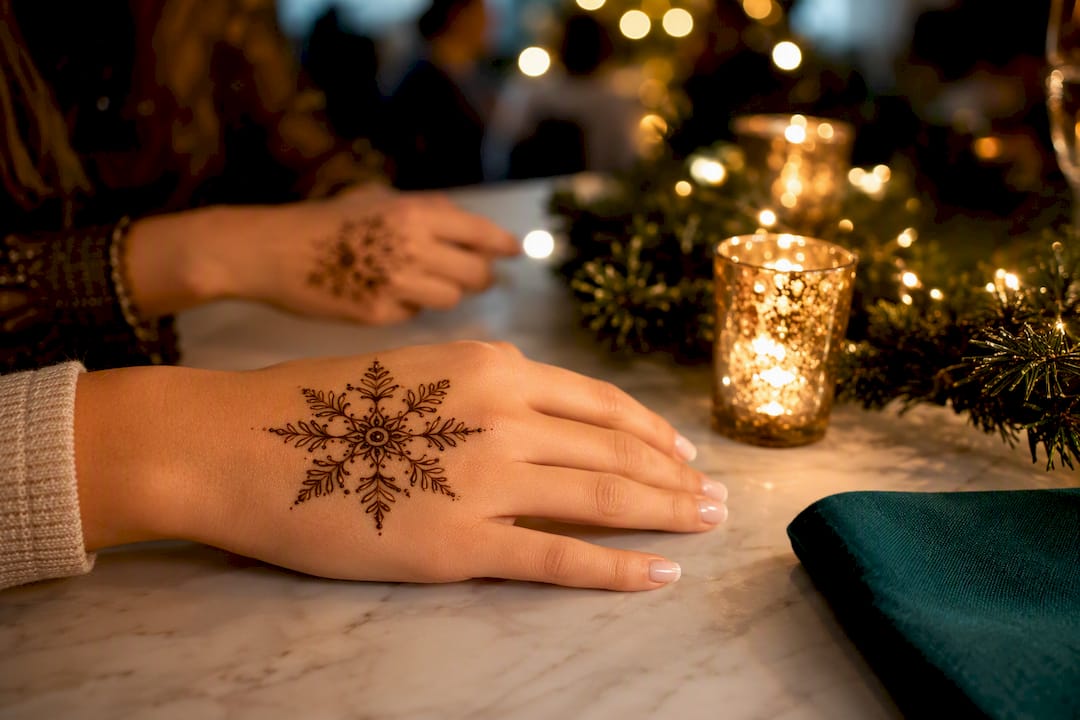
This guide gathers snowflake, tree, and reindeer motifs for Christmas henna designs, plus short tutorials, safety notes, and party formats. Henna For Fun draws on real event and lesson experience to walk you through natural henna’s warm reddish-brown stain range, beginner-friendly placements, and the aftercare that determines how dark your color turns out.
TL;DR:
Snowflake and frost motifs are quick to draw and highly visible in dim lighting, making them ideal for party lineups and brief applications.
Designs like Christmas trees, ornaments, bells, and reindeer are simple to execute in minutes and can be scaled for larger or smaller areas depending on skill level.
Safe henna materials exclude “black henna” with PPD and favor natural henna paste, with patch testing recommended 24 hours prior to application.
Proper aftercare involving long paste application and avoiding water contact enhances the final stain, which develops from orange to deep brown over 24 to 48 hours.
Hosting a DIY henna station or hiring professional artists adds an engaging, participatory element to holiday gatherings, with minimal setup needed for quick results.
Table of Contents
Christmas Henna Design Ideas by Motif and Skill Level
Holiday henna works best when the motif matches the placement. A dense mandala belongs on a palm, not a knuckle, and a snowflake that takes ten seconds to draw is exactly what you want at a party with a line forming behind the chair.
Snowflake and frost motifs. A six-point snowflake with dotted tips is the fastest festive design you can learn, and it reads clearly even in dim party lighting on the back of the hand. A “frost vine” version trails a thin line-up the wrist with tiny snowflake bursts branching off it. For more coverage, a mandala with a snowflake worked into the center panel gives you traditional mehndi structure with a holiday twist, an approach MehndiChic documents across several of its fusion designs.
Christmas tree and ornament clusters. A simple triangular tree with dot “ornaments” fits neatly on a single finger. A fuller version stacks three trees of decreasing size up the forearm, alternating with small circular ornaments to keep the spacing from feeling cluttered. Balance matters more than detail here. Too many ornaments crowd the design; two or three well-placed dots per tree usually look cleaner than a dozen.
Bells, holly, and small accents. A single bell outline with a looping clapper line takes under a minute and works well repeated across four fingers. Holly leaves (two pointed ovals plus three dots for berries) fill gaps between larger motifs nicely.
Reindeer silhouettes and wristlets. A reindeer head profile with simple antler lines makes a playful medium-detail wristlet design, especially paired with a jal (net) background pattern.
Minimalist jingle bells and kid-friendly designs. For young guests or first-timers, a row of three tiny bells connected by a wavy line covers a lot of visual ground for very little skill required. These short, simple holiday designs can be completed in under two minutes, which makes them the default choice for any station expecting a crowd.
Four Quick Christmas Henna Tutorials You Can Try Tonight
Each of these takes 2 to 6 minutes to apply and works with a standard henna cone or a fine-tip applicator bottle.
1. Snowflake on the back of the hand (2 to 3 minutes). Tools: cone or bottle, optional stencil.
Make a small center dot.
Draw six straight lines radiating outward like spokes.
Add two small angled ticks near the tip of each spoke.
Fill gaps with tiny dots if you want extra texture. Beginner shortcut: trace a stencil first, then go over it freehand once you’re comfortable.
2. Finger bells (3 to 4 minutes). Tools: cone, steady hand.
Draw a small bell outline on each finger.
Add a short vertical line and dot for the clapper.
Connect bells with a thin wavy line across the knuckles. Beginner shortcut: skip the connecting line if your hand shakes; standalone bells look just as good.
3. Tree wristlet (5 to 6 minutes). Tools: cone, thin applicator tip.
Draw three triangle “trees” of varying height around the wrist.
Add a short trunk line under each.
Dot ornaments across the branches.
Fill remaining space with small stars or dots. Beginner shortcut: use a stencil for the triangle outlines, freehand the dots.
4. Minimalist reindeer silhouette (4 minutes). Tools: cone, fine tip.
Draw a rounded head shape.
Add two curved antler lines branching upward.
Dot the nose and one eye. Beginner shortcut: keep antlers simple, two or three branches per side.
Pro Tip: Apply thinner lines for finger and knuckle designs since skin there stains faster and darker, and thicker paste lines can bleed before they dry.
Let paste dry fully, roughly 15 to 20 minutes, before touching fabric or jewelry.
Choosing Safe Henna Materials for Holiday Designs
Natural henna paste produces a stain that ranges from warm orange to deep reddish-brown, developing over 24 to 48 hours as it oxidizes. That range is part of the charm: no two stains look identical, and skin chemistry plays a real role in the outcome.
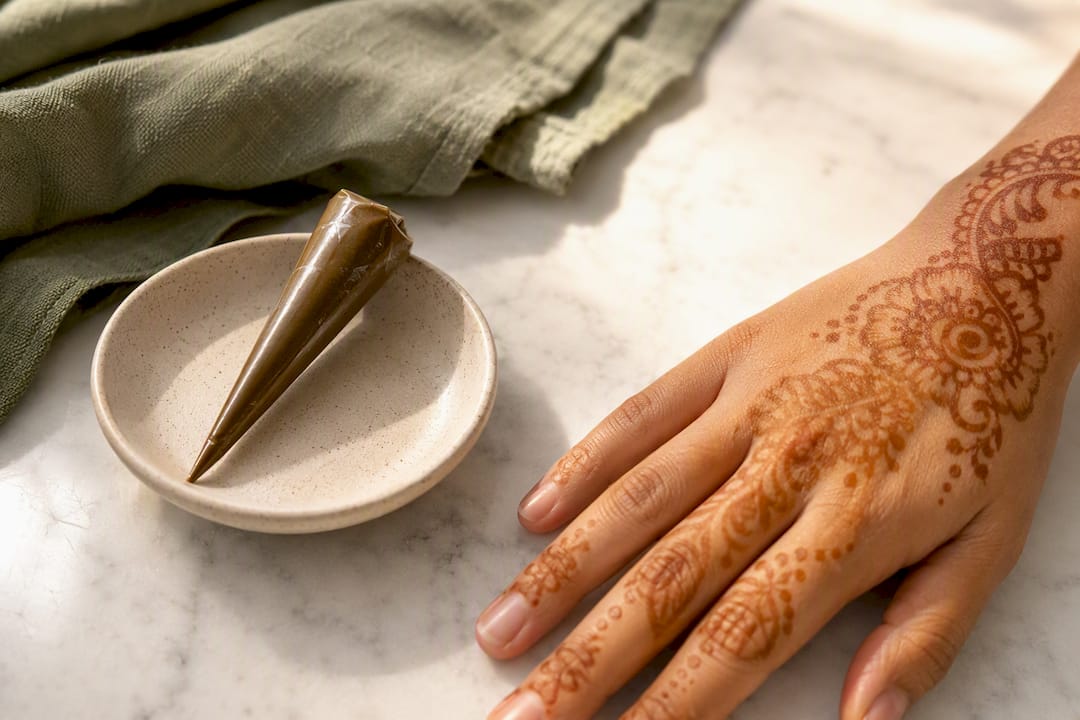
Avoid anything marketed as “black henna.” These products frequently contain paraphenylenediamine, or PPD, a chemical dye that can trigger severe allergic reactions and permanent scarring, according to a health advisory from Better Health Victoria. If a design promises jet black color in minutes, that is the warning sign. Jagua, a plant-based alternative that produces a blue-black tone, is a separate product from henna and shouldn’t be confused with it, since it carries different application and color characteristics.
Before any group event, run a small patch test on the inner wrist and wait 24 hours.
Basic prep kit:
Fresh henna cones or applicator bottles with fine tips
Stencils for consistent motifs
Lemon-sugar mix for sealing
Cotton or nitrile gloves for the artist
Our Henna Rules guide covers U.S.-specific booking and safety details in more depth.
Getting the Darkest Stain After Application
Stain depth depends almost entirely on aftercare, not just the paste itself.
Leave the paste on for at least 4 to 6 hours, overnight if possible, before scraping it off (never wash it off) for a deeper final color.
Seal with a lemon-sugar mix or wrap loosely with medical tape to lock in warmth and moisture.
Avoid water contact, exfoliation, and swimming for the first 24 hours.
Expect the color to start orange and darken to reddish-brown over one to two days. Paste quality, body heat, and skin type all shift the final shade.
For the complete routine, see our henna aftercare guide.
Bringing Christmas Henna Into Your Holiday Party
A henna station adds a hands-on activity that gives guests something to do besides stand around a buffet table. Three formats work well: a mini-design station with an artist doing quick motifs, a stencil-and-stamp corner where guests apply their own with pre-made stencils, or a short 20-minute lesson teaching one or two festive designs.
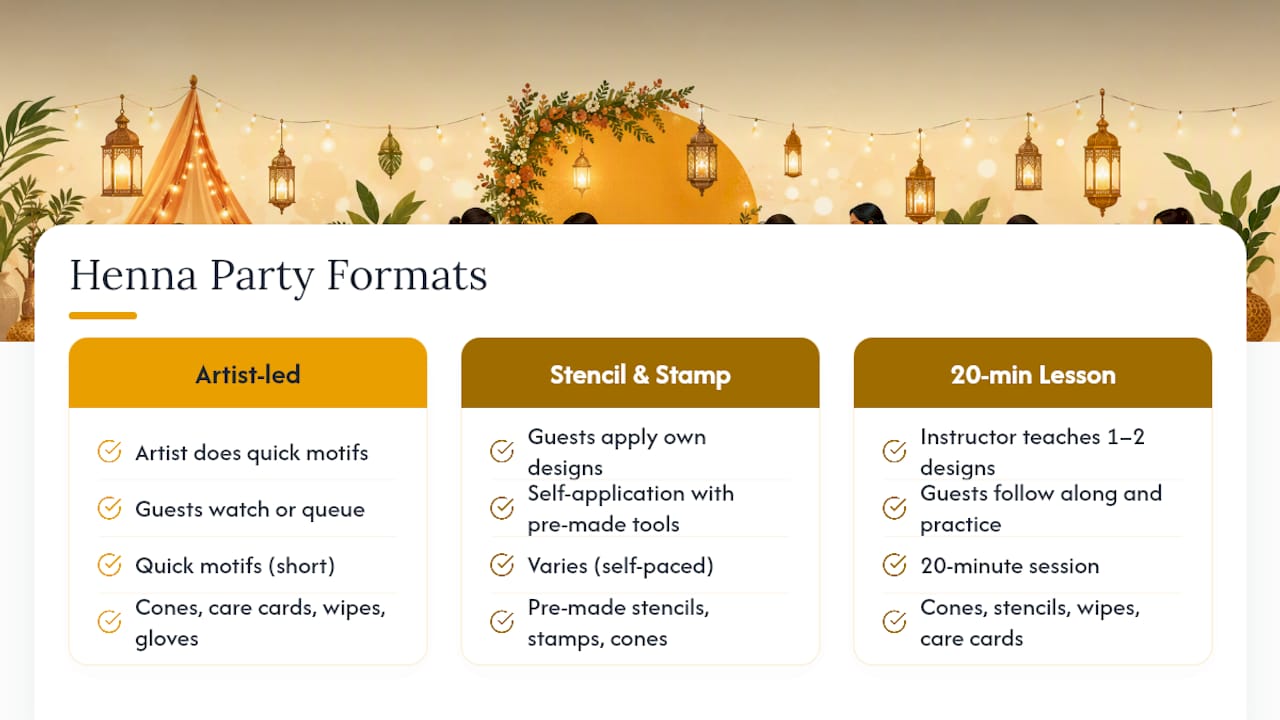
Supplies for a small gathering: cones, stencils, care cards, wipes, and gloves. Run a patch test with any first-time guest before their design goes on. Party favors like DIY stencil packs or mini cones travel well and reinforce that thoughtful setup readers appreciate after the event. For expectant guests, pregnancy henna sessions follow the same safety protocol with designs adapted for the belly.
Why Holiday Henna Sticks Around Long After the Party
Holiday henna works because it turns a passive gathering into something people actually participate in. A quick snowflake or bell takes minutes, so nobody’s stuck waiting in line, and the finished design becomes its own little photo moment without anyone staging it.
What surprises people most is how forgiving the medium is. You don’t need steady hands or years of practice to get a design that looks intentional. Start with dots and simple lines, not intricate mandalas, and the results still read as festive.
If you want guided practice before hosting your own station, a private lesson covering two or three motifs will get you further in an hour than any amount of solo trial and error.
— Angana
Bring Christmas Henna to Your Next Gathering
If you’d rather skip the trial-and-error stencil practice, professional henna services are available, including hired artists for parties and private lessons to learn festive motifs.
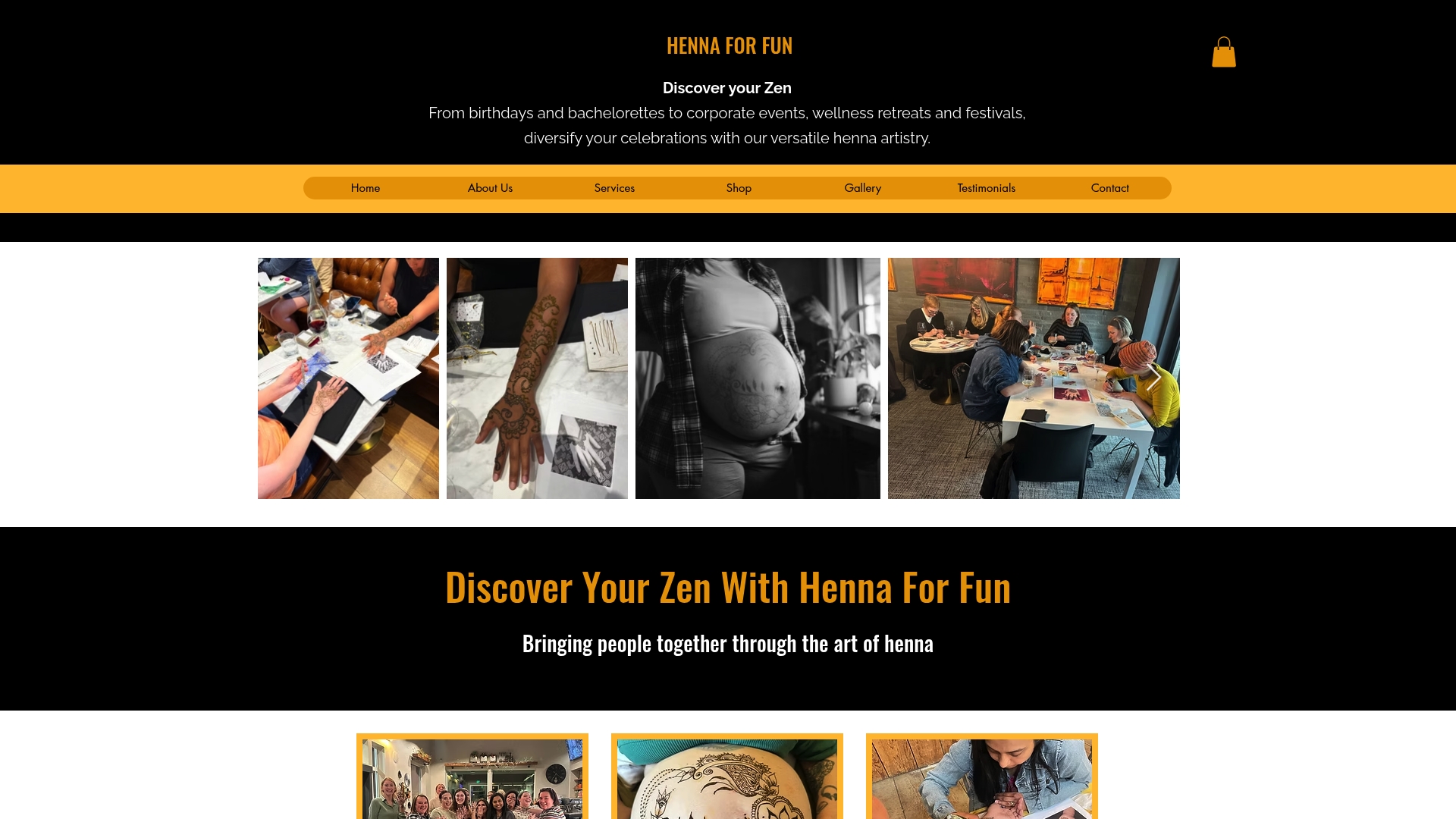
For hosts planning something bigger, Whenna Events bring an artist directly to your home or venue for holiday parties and corporate gatherings. Want to learn the techniques yourself first? Private and group lessons walk you through festive motifs step by step. Expecting a holiday baby? Pregnancy henna sessions add a personal touch to maternity photos. And if you’d rather go the DIY route, handmade henna cones and stencil packs let you set up your own station at home. Check the calendar for open dates and get your holiday event booked.
Sources
FAQ
Is it okay for Christians to do henna?
Henna is a body art medium with no inherent religious affiliation, and many Christians use it purely as decorative art, including for holiday and seasonal designs. If you have personal or denominational concerns, that’s a matter of individual conscience rather than a settled rule.
What are the trends in mehndi design for 2026?
Fusion designs are leading the way this year, blending traditional mandalas, paisleys, and jal patterns with holiday elements like snowflakes, stars, and ornament centers. Subtle body-safe glitter accents are also showing up more often for party and photo use.
What are some common Christmas henna designs?
The most popular motifs include snowflakes, Christmas trees, ornaments, bells, holly, and reindeer silhouettes, often scaled down for quick application at parties. Wristlets and single-finger designs are the most requested placements for casual holiday wear.
How much does henna mehndi usually cost?
Pricing varies by artist, design complexity, and whether it’s a private appointment or an event booking. Henna For Fun’s services page lists current options for lessons, event bookings, and individual appointments.
Recommended
Comments