Corporate Planners: 15–90 Minute Team Building Art That Builds Trust
Art-based team building works because it gives a group two things generic icebreakers rarely deliver: shared focus and a physical artifact everyone can point to afterward. The most reliable formats are facilitator-led collaborative painting or murals, hands-on workshops like pottery and mosaic, and guided henna sessions. Pick three constraints first: how much time you have, how many people are coming, and what you’re willing to spend. The details below help you match the format to the room.
TL;DR:
Art-based team building fosters trust and communication by engaging teams in relaxed concentration activities that reduce hierarchical barriers.
Facilitation quality and a well-structured debrief are critical to ensuring the activity translates into measurable improvements in team dynamics.
Short sessions like paired sketch relays or collaborative doodles are ideal icebreakers, while larger projects such as murals or sculptures serve as memorable, long-lasting artifacts.
Virtual adaptations, including digital storyboards and mail-in craft kits, can keep remote teams engaged but may lack the energy of in-person sessions.
Matching activity complexity and duration to team size, objectives, and budget is essential for a successful, meaningful art team-building experience.
Table of Contents
Why Team Building Art Actually Works
Most corporate icebreakers fail for a predictable reason: they ask people to talk about themselves while everyone stands around holding a drink and looking for an exit. Art-based sessions skip that problem entirely. You hand people a brush, a tile, or a henna cone, and within ten minutes rank stops mattering because nobody in the room is naturally better at mixing paint than the intern who just started last month.
That leveling effect isn’t accidental. Guided creative processes lower hierarchical barriers because the task itself doesn’t reward seniority. A Sweetspot Studio analysis of arts-based workshops found that facilitator-led sessions consistently shift team dynamics by putting everyone on equal footing, and the resulting artwork gives the group something concrete to show for the time spent together.
There’s a psychological mechanism at play too. Hands-on making tends to pull people into a state of relaxed concentration where self-consciousness drops and conversation flows more naturally. That’s why a paint-and-reveal session tends to produce more honest conversation than a scheduled “open discussion” ever will. People talk while their hands are busy, not when they’re asked to perform vulnerability on command.
The measurable outcomes planners actually care about tend to cluster around four things:
Trust: shared vulnerability during an unfamiliar task (nobody’s an expert painter) breaks down performative professionalism.
Communication: collaborative pieces force negotiation over color, placement, and design decisions in real time.
Creativity: stepping outside spreadsheet thinking for an hour measurably changes how people approach problems afterward.
Morale: a well-run session generates the kind of genuine laughter that a trust-fall exercise almost never does.
None of that happens automatically, though. It depends heavily on facilitation quality. A Naboo roundup of team-building crafts notes that the strongest programs treat the debrief as part of the activity, not an afterthought bolted on at the end. Before booking anyone, verify three things: how much facilitation experience the artist or instructor actually has running group sessions (not solo commission work), whether the final piece can be customized to reflect your team or company, and whether there’s an option to display or donate the finished artwork afterward. Those three signals separate a genuine team-building experience from an art class that happens to have coworkers in it.
Pro Tip: Ask any prospective facilitator how they structure the last ten minutes of the session. If they don’t have a clear answer, they’re running a craft class, not a team-building program.
What Art Activities Work Best for Corporate Teams?
The right activity depends almost entirely on how much time you’ve blocked off and how many people are showing up. Here’s a practical menu organized by duration, moving from quick warm-ups to full collaborative builds.
Quick exercises (15 to 30 minutes)
These work as openers before a meeting, a standalone activity during a lunch break, or a warm-up before a longer workshop.
Paired sketch relay. Split the group into pairs. One person describes an object or scene using only words; the other draws it without seeing a reference. Swap roles halfway through. All you need is paper and pencils, and the format works for groups from 6 to 60. It surfaces communication gaps fast, usually with a lot of laughing at the results.
Collaborative doodle chain. Everyone starts a drawing on their own sheet, then passes it to the next person every 90 seconds to add something. By the end, nobody recognizes their original idea, which is exactly the point. Low-material formats like this work well as icebreakers because they require only basic supplies and almost zero setup time.
Gratitude t-shirt sketch. Each person sketches a small design or symbol representing a colleague’s strength on an index card, then hands it over with a short explanation. It’s a compressed version of a longer appreciation format, and it works even with a group that’s never met in person before.
Workshop formats (45 to 90 minutes)
This is the sweet spot for most corporate bookings: long enough to produce something real, short enough to fit inside a half-day agenda.
Collaborative canvas sections. Divide a large canvas or mural board into numbered grid sections, assign one section per small team, and let each group paint independently before assembling the pieces into one image. The reveal moment, when scattered sections suddenly form a coherent picture, tends to be the most talked-about part of the day.
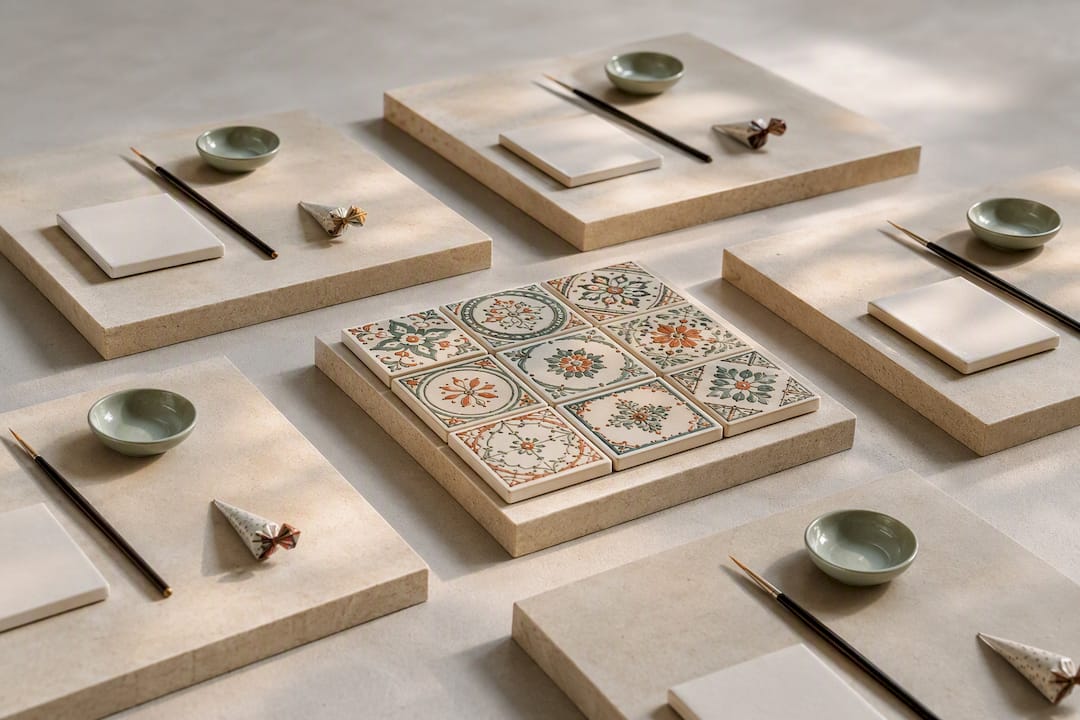
Mosaic tile builds. Teams work with pre-cut tile pieces or broken ceramic to build a shared design, often a company logo or a word that represents team values. Mosaic work forces slower, more deliberate collaboration than painting because pieces can’t be undone once they’re set.
Paint-and-reveal sessions. Groups paint on canvases that have been secretly divided into sections beforehand, following individual instructions without knowing what the final combined image will show until pieces are joined. It’s part art project, part puzzle, and it reliably produces the loudest reaction in the room.
Graffitee-style t-shirt design. Participants design a shirt for a colleague based on that person’s contributions or personality, then present it to them in front of the group. The Graffitee Challenge format pairs creative output with a genuine moment of recognition, which tends to land harder emotionally than most scripted “shout-out” exercises.
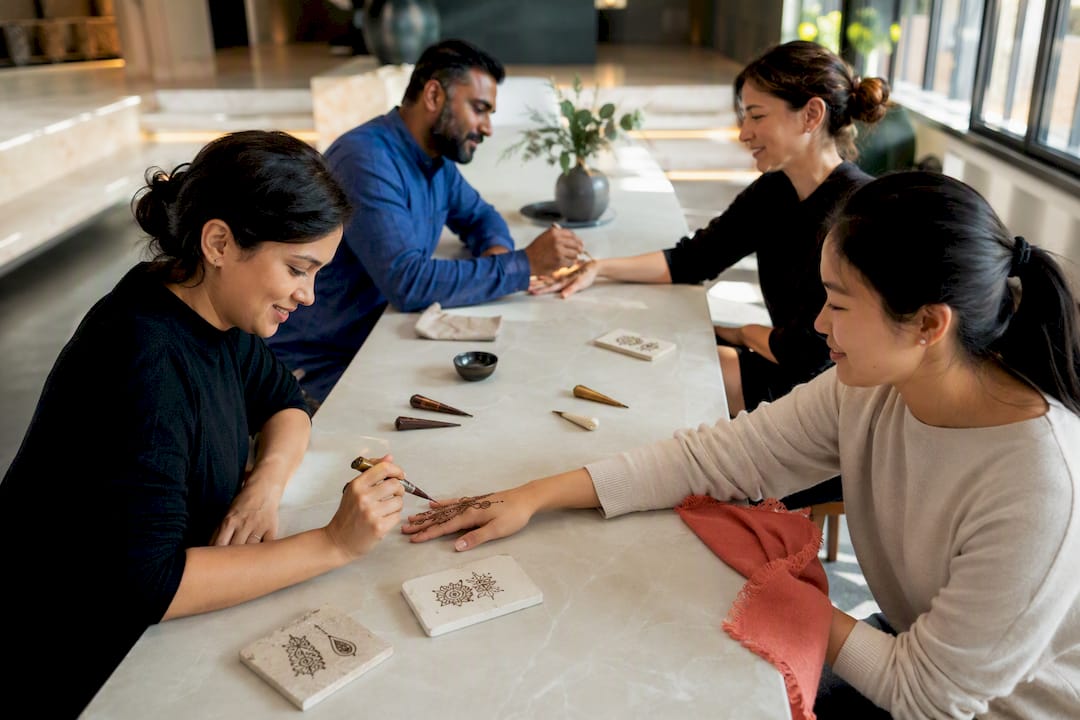
Guided henna session. A facilitator walks the group through basic henna application technique, then pairs participants to practice on each other while discussing the symbolism behind traditional patterns. It’s calming, tactile, and produces a keepsake that lasts on the skin for one to three weeks, giving the event a longer shelf life than a painting that goes straight into a closet.
Half-day and community projects (2 to 4+ hours)
These formats work best as anchor events, department offsites, or annual culture-building days rather than a quick Friday activity.
Giant collaborative mural. Small teams paint individual sections that get assembled into a single large-scale artwork afterward. This format scales unusually well; TeamBonding’s mural program reports groups from around 20 people up to 1,000 working through the same basic structure, and the finished mural becomes a permanent office artifact rather than something that gets thrown away after the event.
Skateboard-for-charity builds. Teams design and paint skateboard decks that get donated to a local youth organization or charity auction afterward. The charitable angle gives the activity stakes beyond team bonding, which tends to matter more to leadership teams evaluating ROI.
Sculpture and tinkering builds. Groups work with cardboard, wire, foam, or reclaimed materials to construct a freestanding sculpture based on a brief (a company value, a mascot, an abstract concept). Tinkering-style builds mirror real project phases: brainstorm, plan, assign roles, execute, and this structure makes visible who naturally coordinates, who tests, and who quality checks under time pressure. It’s one of the more revealing formats on this list precisely because failure is part of the process; something usually collapses, and how the group responds tells you more than the finished piece does.
Virtual and hybrid adaptations
Distributed teams don’t have to sit this out. A few formats translate cleanly to remote settings:
Digital storyboard collaboration: teams build a shared visual narrative using a collaborative whiteboard tool, with each person contributing one frame.
Remote zine building: participants create one page each around a shared theme, then a facilitator compiles the pages into a digital or printed team zine.
Collaborative slideshow collage: each person submits one image or drawing representing a project milestone, assembled live into a shared presentation during the call.
Mail-a-kit henna or craft sessions: physical supplies get shipped to home addresses ahead of a scheduled video session, so remote participants get the same hands-on element as an in-person group.
None of these fully replace the energy of a shared physical room, but they close the gap enough to keep distributed teams from missing out entirely.
How Do You Choose the Right Art Activity for Your Team?
Start with five questions before you look at a single vendor’s portfolio: What’s the actual goal (trust, recognition, creative reset, or just morale)? How many people are attending? How much time is realistically available? What’s the budget ceiling? And does anyone in the group have accessibility needs that rule out standing for hours or fine motor tasks?
Matching activity type to a specific goal isn’t a nice-to-have; it’s the difference between an event people remember fondly and one that gets forgotten by Monday. Decision frameworks that pair the activity to a stated objective tend to reduce mismatch and raise perceived ROI for the HR teams footing the bill. A mosaic build aimed at “trust” but run with zero debrief structure won’t deliver trust. A henna session aimed at “creative reset” run in a loud, cramped room won’t deliver calm.
Once you’ve settled on a rough direction, vet the vendor or facilitator with a short, direct list of questions:
How many corporate groups has the facilitator led, specifically (not solo art commissions)?
Who handles cleanup, and is that included in the quoted price?
Does the facilitator or company carry liability insurance for the venue?
Are all materials provided, or does the group need to source anything separately?
What does the debrief or discussion structure look like at the end of the session?
Can you customize the design or theme to reflect your company, team, or specific occasion?
Watch for a few red flags before signing anything: vague pricing that turns into add-on fees for materials or cleanup, deliverables described only in general terms (“a fun creative experience”) with no specifics on what participants walk away with, and an inability to provide references from a past corporate client. A legitimate facilitator should be able to name at least one past group they’ve worked with.
Pro Tip: If a vendor can’t answer “what happens in the last ten minutes” clearly, ask a second question: “What do people take home?” A facilitator with a real program always has an answer to both.
Timing, Budget, and What to Bring
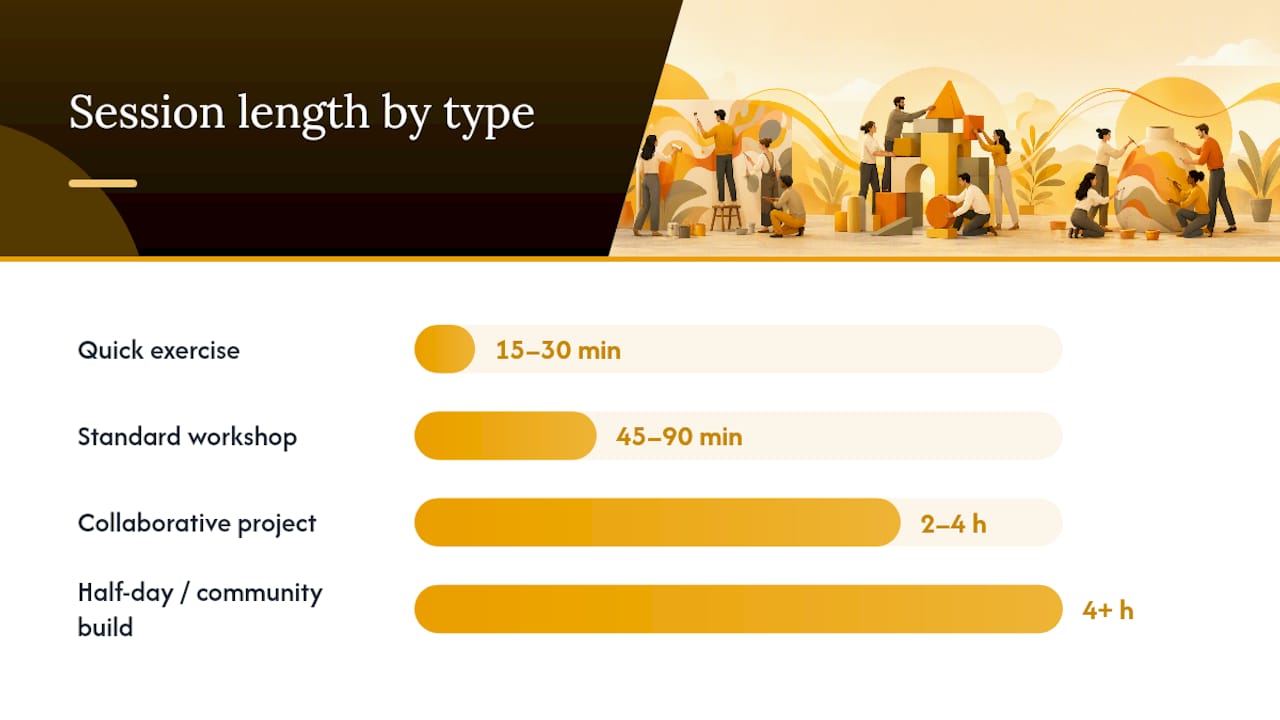
Session length determines what you can realistically accomplish, and mismatched expectations are the number one reason art team-building events disappoint planners. A 30 minute slot works fine for a quick warm-up or icebreaker, but don’t expect a finished collaborative mural in that window. Reserve the longer formats for when you actually have the room booked for it.
Cost varies more by facilitation model than by activity type. DIY sessions where a planner buys supplies and runs the activity internally without a hired artist tend to run in the $25 to $50 per person range for basic materials. Fully facilitated sessions with a professional artist leading the group cost more, and the spread is wide because it depends on group size, session length, travel, and whether the facilitator supplies premium materials versus basic ones.
Session type | Typical length | What it accomplishes |
Quick exercise | 15–30 minutes | Icebreaker, warm-up, low-stakes fun |
Standard workshop | 45–90 minutes | A finished individual or small-group piece plus real discussion |
Collaborative project | 2–4 hours | A single large shared artifact (mural, mosaic, sculpture) |
Half-day/community build | 4+ hours | Multi-phase project with planning, building, and a reveal event |
For supplies, the checklist changes by activity, but a few things stay constant across formats: drop cloths or table covers, hand-washing or wipe stations, good lighting, and enough table or wall space for the group size. Painting and mosaic sessions need drying or curing time built into the schedule if pieces travel home the same day. Henna sessions need almost no cleanup at all beyond a few napkins, which is part of why it works well in venues that don’t allow paint on the walls, including wineries and private homes.
Sample Agendas You Can Adapt
15 to 30 minute quick session
Minutes 0 to 3: Opening framing. Explain the exercise and the one rule (no talking during the drawing phase, for example).
Minutes 3 to 20: Hands-on activity (paired sketch relay or doodle chain).
Minutes 20 to 30: Quick share. Each pair or small group holds up their piece and explains one surprising moment.
60 to 90 minute standard workshop
Minutes 0 to 10: Welcome and framing. State the goal out loud (trust, creative reset, recognition) so the group knows why they’re there.
Minutes 10 to 20: Facilitator demo. Show the technique (brush handling, tile placement, henna cone pressure) before anyone touches materials.
Minutes 20 to 70: Hands-on creation time, with the facilitator circulating and offering light guidance rather than instruction.
Minutes 70 to 80: Reveal or share moment, where pieces are displayed and discussed as a group.
Minutes 80 to 90: Structured debrief. Ask two direct questions: “What surprised you about working with this group?” and “What’s one thing you’ll do differently at your desk tomorrow?”
Half-day collaborative project
Hour 0: Kickoff and goal-setting. State what the finished piece needs to represent and why.
Hour 0.5 to 1: Planning phase. Small teams sketch their section, tile pattern, or sculpture piece before touching final materials.
Hours 1 to 3: Build phase, with a facilitator checking in on each subgroup and troubleshooting stalled progress.
Hour 3 to 3.5: Assembly and reveal. Sections come together into the finished collaborative piece.
Hour 3.5 to 4: Reflection and next steps. Decide where the piece will live (office wall, donation, digital photo for internal newsletter) and close with a short round of one word per person describing the day.
What Does a Henna Team-Building Workshop Actually Look Like?
A typical Henna For Fun corporate session follows a structure that maps closely to the workshop format above: a short introduction to henna’s history and symbolism, a live demo of basic application technique, guided hands-on practice where participants pair off to apply simple designs on each other, and a closing share where people compare their finished patterns before a group debrief.
Henna fits corporate groups for reasons that go beyond novelty. The activity is inherently calming and slow-paced, which makes it a strong counterweight to a team that’s coming off a stressful quarter. Designs can be personalized around a company theme, an employee milestone, or a shared symbol chosen by the group, and every participant walks away with a visible keepsake that lasts one to three weeks, not just a photo that lives in a shared drive and gets forgotten.
A few things worth knowing before booking:
Sessions require almost no cleanup, which makes venues like wineries, offices, and private homes easy to book without damage concerns.
Group sizes can range from small private lessons to larger corporate workshop formats depending on how many artists are staffed.
Designs are customizable to reflect company branding, a shared word or symbol, or an individual milestone within the group.
The tactile, low-stakes nature of the activity tends to lower guardedness faster than higher-pressure creative formats like public painting.
What Facilitators Notice When Teams Shift From Roles to Peers
There’s a moment in almost every session, usually around the halfway mark, when the room’s energy visibly changes. Someone who’s been quiet the whole meeting cracks a joke about their own crooked design. The person running the department stops correcting anyone’s technique and just starts talking about their weekend. That shift from job title to person is the entire point of the exercise, and it happens faster in art-based sessions than in almost any other team-building format because nobody’s competing for a right answer.
Quiet groups usually need a facilitator to lower the bar explicitly, saying something like “there’s no wrong way to do this” more than once in the first ten minutes. Competitive groups need the opposite treatment: give them a shared goal instead of individual scoring, or the activity turns into a contest instead of a collaboration.
The follow-up matters as much as the session itself. Display the finished piece somewhere visible instead of letting it disappear into a closet, and schedule a short reflection check-in a week or two later. A single afternoon rarely changes how a team works long-term, but a mural on the breakroom wall or a henna design someone still has weeks later keeps the memory active far longer than a one-time event ever could on its own.
— Angana
Book a Henna Workshop for Your Team
If your team needs an art experience that requires zero cleanup, works in almost any venue, and sends every participant home with a personal keepsake, a guided henna session covers ground that painting and pottery workshops can’t touch. Sessions can be designed to accommodate corporate constraints such as tight timelines, mixed skill levels, and participants preferring not to get paint on their clothes.
Our corporate workshops scale from small teams to larger department gatherings, with every design customizable to a company theme, a shared symbol, or an individual milestone worth celebrating. Whether you’re planning a standalone session or pairing henna with a broader Whenna Event at a winery or private venue, the format works within the same 60 to 90 minute window most workshops already use. If your team prefers to build skills over a series of sessions rather than a single afternoon, private and group lessons offer a structured path from first design to independent practice. Check current openings on the calendar and get a session booked before your next planning window closes.
Sources
For planners comparing formats beyond henna, TeamBonding’s mural program breaks down large-scale collaborative painting for groups of nearly any size. Sweetspot Studio covers the psychology behind facilitator-led arts workshops in more depth. TeamBuilding.it’s tinkering programs offer a useful model for groups that want a build-based challenge instead of a purely artistic one. And if your session includes a wellbeing component alongside the creative work, The Pursuit Counseling’s workshop resources offer a useful framework for facilitators balancing group process with emotional safety.
Recommended
Comments