Pride Henna Designs: Ideas, Meanings and Safe Application

A good Pride henna design takes one idea you care about, such as a flag, a symbol or a pair of names, and sets it inside the flowing patterns henna has always used. Henna paste is a brown-green plant paste that stains the top layer of skin for about a week or two, so a Pride design is a low-commitment way to wear your colors for a parade, a party or a pride month weekend. This guide covers what the colors mean, which motifs suit which part of the body, how to apply and care for a stain, and how to get a design done with us in Washington.
TL;DR
Natural henna stains in shades of orange to reddish brown, so rainbow color usually comes from the flag’s structure (stripes, bands, ordered dots) and from the motifs, not from literal paint-like color.
Choose a flag (original rainbow, Progress, trans, bisexual, asexual, non-binary) and translate each color into a pattern element: flowers, vines, paisleys, dots, bands.
Use natural henna only. “Black henna” can contain PPD, a chemical that causes serious skin reactions.
Plan on 4 to 12 hours of paste time, then keep the stain dry for the first day, and expect the darkest color at 24 to 48 hours.
For a group, a Pride party or a workplace event, we run henna sessions from $25 per participant.
Table of Contents
What a Pride henna design really looks like
Most people searching for Pride henna designs expect a rainbow on the skin. Natural henna does not work that way. The stain starts dark brown when the paste is first removed, then develops into orange that darkens to red-brown. That is the whole palette. The rainbow, then, lives in the design language rather than in the pigment.
There are four dependable ways artists carry Pride into a henna design:
Structure. Six or seven bands across a wrist, forearm or ankle, one for each flag stripe, each filled with a different pattern (dots, lines, scallops, tiny petals). The eye reads the order of the stripes even without color.
Symbol. A raised fist, a heart, a triangle, a lambda, an equals sign or a pair of interlocked symbols, drawn in outline and filled with henna shading.
Botanical. Flowers, vines and leaves in the colors’ stead. Violets and lavender have long been coded queer symbols, so a violet sprig is a quiet way to say it.
Text. Names, initials, a date or a short word, set into a mandala or running along a collarbone.
Some people add a temporary color layer after the henna has set, such as skin-safe body paint for a parade day. That is a styling choice for the day, and the henna itself stays natural.
What Pride colors mean, and how to turn them into patterns
Knowing what each stripe stands for helps you decide where the weight of your design goes. In the original 1978 flag, Gilbert Baker assigned meanings: red for life, orange for healing, yellow for sunlight, green for nature, turquoise for magic and art, blue for serenity, violet for spirit, and hot pink for sex. Baker treated color as a symbolic language, which is a useful way to think about a henna design too: each band can carry its own meaning.
Here is how that translates into pattern choices:
Color / stripe | Meaning | Henna idea |
Red | Life | Small hearts or a continuous vine with a steady rhythm |
Orange | Healing | Sun-like circles, open petals |
Yellow | Sunlight | Rays, dot clusters radiating from a center |
Green | Nature | Leaves, ferns, trailing vines |
Turquoise or blue | Art, magic, serenity | Waves, swirls, moon and stars |
Violet | Spirit | Violet or lavender sprigs, a lotus |
Black and brown | Queer people of color | Solid filled bands, bold geometric blocks |
Light blue, pink, white | Trans identity | Three-band stack with a central diamond or ring |
Which flag should you pick?
The flag you choose changes the layout. A few that translate well:
Rainbow flag. The classic. The Progress Pride flag, designed in 2018 by Daniel Quasar, builds on it with light blue, pink, white, brown and black stripes for trans and non-binary people and for communities of color.
Philadelphia flag. The Philadelphia Rainbow Flag, from 2017, adds black and brown stripes for queer people of color. It suits a wide forearm band.
Trans flag. Light blue, pink and white. Three bands are easy to draw cleanly, so it works even on a small space like a finger or the back of the neck.
Bisexual flag. Pink, purple and blue (1998). Its proportions, with the purple band narrow, make a good tapered design along a finger or wrist.
Asexual flag. Black, grey, white and purple. Rich solid black-looking shading in henna is hard to get, so ask your artist to use dense line work to suggest the dark band.
Non-binary flag. Yellow, white, purple and black stripes (2014).
The same UC Santa Barbara glossary lists many more. If your flag is not here, bring a picture. A good henna artist can read a flag like a layout plan.
Roots worth knowing before you draw
Henna is not a Pride accessory that was invented in a Pride shop. According to reporting in Them, henna stretches back almost 9,000 years across North African, Arab and South Asian histories, and in South Asia hijra communities, who are legally recognized as a third gender, have long been woven into community life through saris, jewelry and henna art.
Queer South Asians today use henna to reconnect with that heritage. British Vogue profiles a Toronto man who began a pre-Pride mehndi tradition, and a couple in Mumbai who wore each other’s names on their palms for their pre-wedding mehndi. The same piece describes a drag performer who uses simple red fingertip dots to honor classical Indian dancers.
That history is a good guide for design. Traditional motifs carry their own meaning: flowers for joy, vines and leaves for growth and renewal, paisleys for luck and fertility, circles and dots for unity. Pairing those with your flag colors gives a Pride design depth instead of making it a sticker on skin. If you want the longer story, our piece on 4,000 years of henna history goes further back.
Design ideas by placement
Where you wear the design decides how detailed it can be. Henna stains darkest on the palms and soles and lighter on the arms, back and neck, and fine detail shows best where the skin is thin and smooth.
Hands and fingers
The hand is the traditional canvas, and the one people see most at a parade. Ideas:
A narrow stripe stack running up one finger, each stripe a different tiny pattern.
A palm mandala with a heart at the center and flag bands as the outer rings.
Names or initials tucked into the palm, the way a couple might wear them.
Fingertip dots in a color sequence for a minimal look.
Forearm and wrist
The forearm gives room for the full flag as a wrapped cuff or a long vertical panel. A cuff of seven bands around the wrist is bold and legible from across a room. A vine climbing from wrist to elbow with a violet flower at the top is softer.
Shoulder, collarbone and neck
These spots suit symbols and text. A line of script along the collarbone, a lambda or triangle on a shoulder blade, or a mandala at the base of the neck works well. Expect softer, lighter stains here, so choose bolder line weight.
Ankle and foot
Feet take henna deeply. A chain of flowers around the ankle with flag-colored band spacing is a good beachy option. A foot with a heart and a vine is a favorite for summer parades.

Simple versus detailed
A simple design takes 10 to 20 minutes and is ideal for a party where many people want something. A detailed design with multiple bands and fill work takes longer and rewards a steadier setting. If you are planning a group, mix both: a quick stripe or symbol for most guests, and a larger piece for the guest of honor.
How to apply and care for a Pride henna design
If you are doing a design yourself or just want to understand what your artist is doing, here is the routine.
1. Start with real henna
Natural henna paste is greenish-gray and turns orange when moistened. Black henna is a different thing. It can contain PPD (p-phenylenediamine, a hair-dye chemical), and in tests the FDA found it at concentrations of 4% to 27% in black henna products. MedicineNet lists oozing blisters, scarring and sensitization among the reactions, which can appear 3 to 12 days later. A paste labeled “black” or one that stains jet black in minutes should be passed on. Our guide to natural henna ingredients explains what a safe paste looks like.
2. Check your skin first
If you have sensitive skin or have never worn henna, do a small patch test and wait before you commit to a large design. We cover how in our henna allergy test and 48 hour patch test guides. Anyone with known G6PD deficiency should avoid henna entirely and talk to their doctor. If you are pregnant, read our pregnancy henna safety guide and check with your doctor or midwife.
3. Prepare the skin and draw
Start with clean, dry skin free of lotion. Paste goes on through a cone or a fine-tipped applicator, lines first, fills after. Draw your flag bands before the details so that spacing is even. Handmade cones make this much easier; ours are on the henna cone page, and DIY stencils help with symbols such as a heart or a clean stripe stack.
4. Let it develop
Leave the paste on for roughly 4 to 12 hours, kept warm and slightly moist so it can release its dye. Longer contact generally gives a deeper stain, and our guide on how long to leave henna on skin goes through the trade-offs. Then scrape it off, without water, and avoid water for the next 12 to 24 hours. The color peaks at 24 to 48 hours.

5. Aftercare
Once the stain has set, it will last about 4 to 7 days on skin, and a bit longer with good care. Moisturize gently, avoid scrubbing, and keep chlorinated water off it. Time the application two or three days before Pride so the color is at its richest on the day. Our henna aftercare and guide to making henna stain darker walk through it in detail.
A note on darker skin tones
Henna reads differently on deeper skin: the stain is more subtle, a rich brown rather than a bright orange-red, so bold line weight and dense fills help. Our guide to henna on dark skin shows how it looks and how to go darker. If you are matching a design to a Pride-day outfit and look, these makeup techniques for dark skin are useful for planning color around the stain.
Pride henna for groups, parties and workplaces
Henna works well as an activity because everyone gets to make a choice and leave with something. A few settings where Pride designs fit:
A Pride weekend gathering at a home, where friends take turns choosing a flag or symbol.
A couples date night, each partner wearing the other’s initials or a shared symbol.
A workplace Pride event. A shared creative activity gives colleagues something to talk about and keeps an inclusion event from being only a slide deck.
A festival or party. Our festival henna designs piece covers timing and ideas for events with big crowds.
Book Pride henna with Henna For Fun
We bring henna to wineries, homes and corporate settings across the Seattle area, including Bothell, Lynnwood, Snohomish and Edmonds. Our Whenna Events are priced per participant: Basic starts from $25 and Plus from $35. Premium Option 1 starts from $35 per design per participant, Premium Option 2 is $200, and an additional hour is $85.
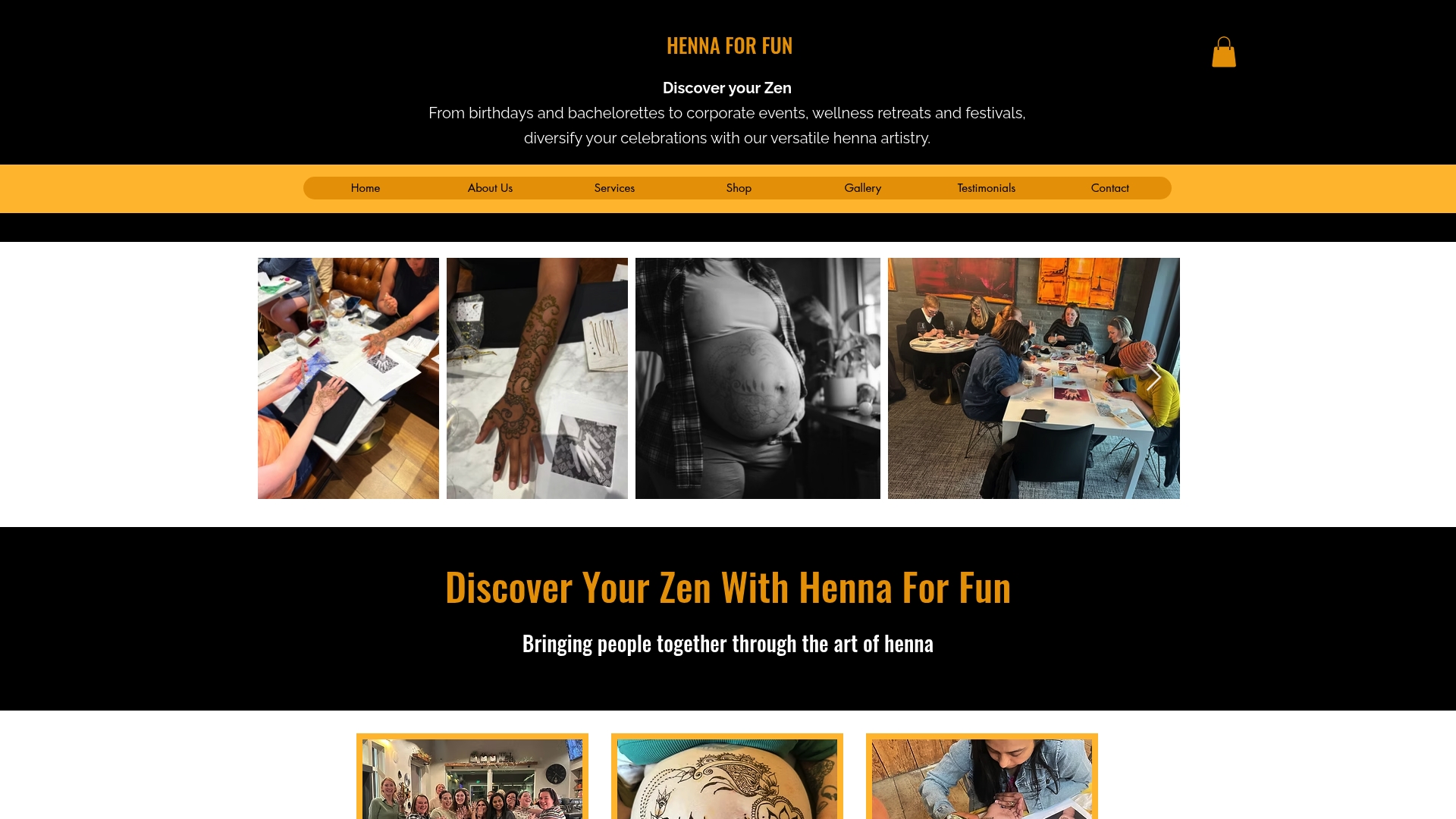
For workplaces, we offer corporate workshops suited to team activities and DEI programming. If you would rather learn the craft so you can draw your own flag designs, our lessons include a 3-day course at $111, a 5-day course at $179, and a henna mixing and cone-making session at $99. You can see what is coming up on our calendar or browse all of our services.
Our perspective
Pride henna works best when the design says something true about the person wearing it. We start by asking what the person wants to carry: a flag, a name, a feeling. Then we build the pattern around that, using the traditional language of henna, flowers for joy, vines for growth, dots for unity, so the piece is both personal and rooted. We love that henna sits between art and celebration. It is calming to receive, it is social, and it does not ask for a permanent decision. That is why it fits a Pride weekend, a baby shower, a team afternoon or a quiet date night equally well. Our approach combines traditional henna artistry with modern, interactive group experiences, and we keep every session inclusive and flexible. Whether you want a single stripe on a finger or a full flag across the forearm, the goal is that you leave with something you are proud to wear. Angana
FAQ
Can henna actually be rainbow colored?
Natural henna stains in tones from orange to reddish brown, so it cannot produce a true rainbow on its own. Artists suggest the flag through stripe order, pattern variety and symbols. Some people add skin-safe body paint for a single event day.
Do different henna designs have different meanings?
Yes. In traditional henna, flowers are linked with joy, leaves and vines with growth and renewal, paisleys with luck and fertility, and circles and dots with unity. Pride designs layer flag-color meanings on top of these, such as red for life or green for nature.
How long will a Pride henna design last?
Natural henna usually lasts about 4 to 7 days, and the color reaches its darkest at 24 to 48 hours. Hands and feet hold the stain longest. Apply it two or three days before your event.
How can I tell natural henna from black henna?
Natural henna paste is greenish-gray and turns orange when moistened, and it should come with an ingredients list. Black henna may contain PPD, which can cause serious reactions, so choose natural paste only.
How much does a henna artist cost for a Pride party?
Our Whenna Events start from $25 per participant for Basic and from $35 per participant for Plus, with additional hours at $85. For a workplace event, see our corporate workshops page.
Sources
Recommended
Comments