Quinceañera Henna: Ideas, Planning and Safety for the Party

Henna works at a quinceañera because it gives guests something to do with their hands and each other: an artist sets up a table, guests sit down one at a time, and everyone leaves with a design that matches the celebration. The best way to get it right is to book a henna artist who comes to your venue or home, builds the designs around your colors, and uses plain henna paste only. At Henna For Fun we run these as interactive events, so the family plans the party and the artist plans the henna.
This guide covers what quinceañera henna involves, which designs and placements work, how to plan the timing, how to keep the paste safe, and what an event costs with us.
TL;DR
Hire an artist to apply freehand designs to guests at the party, themed to the quinceañera’s colors, flowers or monogram.
Choose designs by placement: palms, hands and wrists hold the darkest stain, while upper arms and shoulders need bolder, simpler lines.
Use only real henna paste, which stains reddish-brown. In the US the FDA warns that “black henna” often contains PPD, which can cause dangerous skin reactions.
Schedule henna early in the party, away from the dance floor and the food, so designs have hours to set.
Our Whenna Events start at $25 per participant for Basic and $35 per participant for Plus.
Table of Contents
What henna at a quinceañera looks like
A quinceañera marks a girl’s 15th birthday, and the party is built around moments: the entrance, the dances, the toast, the photos. Henna adds a quieter activity between them. A hired artist applies temporary designs to guests, who pick from a range of motifs for hands, arms or other places, and the designs can follow the party’s theme or colors. Guests gather around the table to watch the lines take shape, which makes the artist’s station a conversation spot as well as an activity.
Henna is a paste made from the dried leaves of the henna plant. It does not sit on the skin like ink. It dyes the outer layer of skin and fades as that layer sheds, which sun and water speed up. That is why a henna design is a good fit for a one-day celebration: it is temporary, it needs no needles, and a guest who is nervous about a first design can start small.
There are three common ways families use it:
Guest henna. An artist applies small designs to guests throughout the party. This is the most popular format.
Court henna. The quinceañera and her damas and chambelanes get matching or coordinated designs before the event, often with photos in mind.
Henna pre-party. A smaller gathering at home the week before, with the girl, her mother, godmothers and close friends. It works as a relaxed bonding event and removes pressure from party day.
Choosing designs and placement
Start with the placement, because it decides how detailed the design can be. Stain follows skin thickness: hands and feet stain darkest, forearms medium, and shoulders and torso lightest. So fine, lacy work belongs on the hands and wrists, and designs further up the arm should be bolder and simpler. The wrist or inner forearm is the most popular spot for a first henna and holds color for about two weeks.
For the quinceañera herself, a design on the back of the hand and wrist photographs well with a ball gown and long gloves off, and it shows in the first dance and toast photos. A palm design carries the most detail but is hidden whenever her hands are down.
Styles that suit a quinceañera
Most guest-henna styles fall into a few families. Arabic henna uses bold florals and is a common party choice, which makes it a good match for guests who want something quick and graceful. Indian-style mehndi is denser, with paisleys and nested borders, and takes longer. Moroccan work is geometric. Minimalist designs, such as a finger band, a ring pattern or a single flower on the wrist, are fastest and suit guests who are trying henna for the first time.

White or glitter “henna” is body paint, not henna. If you like the sparkle, it can be an accent on top of a real design rather than a substitute.
Personalizing without losing the tradition
The designs that people remember are the ones with a personal detail inside a traditional frame. Traditional henna can be personalized by hiding initials in the vine intersections, swapping the center of a flower for a meaningful symbol, or framing a mandala with petals that match the number of family members, while the traditional structure of symmetry, flowing lines and borders stays in charge. For a quinceañera, that might mean a 15-petal flower, the birthday girl’s initial worked into a vine, or the party’s flower, such as roses or marigolds, repeated across the court’s designs. If you enjoy the thinking behind adapting a motif to a person, this piece on personalizing a design motif walks through the process for tattoos, and the same logic of keeping the structure while changing the details applies.
Henna also carries meaning in many cultures. It appears in Moroccan Jewish weddings, West African good-luck and baby-naming customs, and in South Asian bridal tradition, where hands and feet are decorated with designs that echo wedding-dress embroidery while guests sing and dance. A quinceañera is its own tradition, so the respectful approach is to treat henna as a party art form, name it for what it is, and let the artist explain the motifs they use. For more on the symbolism behind the patterns, there is a good overview of henna traditions and symbolism.
How to plan henna for your quinceañera
These steps keep the henna running smoothly, and they show where an experienced event artist takes work off your hands.
1. Decide who gets henna and how much
Settle whether it is a guest activity, a court-only moment or both. A short list of small designs keeps the line moving. Larger, more elaborate designs take longer, so reserve them for the quinceañera and her court, ideally before the party starts. Ask your artist how many guests they can serve in your time window and book a second artist for a big guest list.
2. Pick the time slot
Put henna early, once guests have arrived and settled with something to drink and eat. The family-focused account of a henna party suggests applying designs to areas that will not be touched for a few hours, such as wrists, hands and ankles, and holding the event earlier in the day so the henna has time to dry. Guests can eat, chat and mingle while designs set. Then plan the loud, hands-on moments, such as dancing, group photos with props and the cake, for after.
It also helps to remind guests in the invitation or a message beforehand: exfoliate the skin the day before, wear loose sleeves that will not rub the design, and expect to keep the paste on for a while.
3. Choose the space
The artist needs a table, two chairs per artist, good light and a spot where guests can sit without getting bumped. Put the station near the refreshments but away from the dance floor. If you want the table to feel like part of the party, our guide to henna party decoration ideas covers lighting, fabrics and table styling, and henna party games has activities for guests waiting their turn or letting their paste dry.
4. Brief the artist on the theme
Send your colors, flowers, monogram and any photos of the dress or decor. A good artist will build a short menu of designs from these. Settle who wants what before the day: a limited menu is faster than free choice and keeps designs consistent in photos.
5. Plan the paste time and aftercare
Henna paste is left on for around two to six hours, and the color keeps darkening over the next two to four days. The longer it stays on, the darker the stain. At a party, guests often will not keep the paste on that long, and that is fine: a lighter orange stain that deepens by the next day is normal. A common finishing step is to dab a lemon and sugar mixture over the dried paste to help it stay in place. In one henna party account, this was done after about 15 minutes. Guests can also cover the design while sleeping. Our guides on how long to leave henna on skin and henna aftercare give you something to share with guests, so aftercare does not fall to you at the end of the party.

6. Think about the weeks around the party
If the quinceañera wants a dark stain for photos, book her henna one to three days before the event rather than the same day, so the color has time to deepen. Keep her hands out of long soaks and hot water for the first day.
Safe henna: what to look for
This is the part not to skip. Real henna stains skin a brown, orange-brown or reddish-brown shade. The FDA states that other colors, such as black henna, require added ingredients, often PPD, which can cause dangerous skin reactions. PPD (para-phenylenediamine) is a dye chemical that is not permitted in cosmetics applied to skin.
A few rules of thumb follow from that:
Never use black henna. Paste that stains black right away, or that lists PPD, para-phenylenediamine or an unidentified hair dye, should not touch skin. Genuine henna darkens gradually over 24 to 48 hours.
Ask what is in the paste. A professional can tell you the ingredients. Our guide to natural henna ingredients explains what a plain paste contains and why PPD has no place in it, and our piece on avoiding black henna goes deeper on the difference between henna and tattoo ink.
Know the US rules. The FDA says henna is approved in the United States only as a hair dye, not for direct application to skin. That is a reason to be particular about the paste and the person applying it.
Do a patch test for sensitive skin. A small amount on the inner arm or elbow crease, checked for redness, itching or swelling after 24 to 48 hours, shows how a guest’s skin reacts. Our 48-hour patch test guide walks through it. Any guest with a reaction, allergies or a skin condition should see a doctor before having henna.
Keep hygiene visible. Look for a clean workspace, fresh paste for each guest and clear aftercare instructions.
If younger siblings or cousins will be at the party, kid-friendly henna guidance suggests simple hand designs for ages 5 to 6 and up, on the backs of hands, wrists or tops of feet, never near the face, eyes or broken skin, with short paste time of 30 to 60 minutes. For toddlers, check with a pediatrician first.
What henna costs for a quinceañera with us
Prices depend on the format, the number of guests and the time you book. Here is what we publish for our Whenna Events, which are interactive henna events at homes, venues and wineries:
Option | Price |
Basic | from $25 per participant |
Plus | from $35 per participant |
Premium Option 1 | from $35 per design per participant |
Premium Option 2 | $200 |
Additional hour | $85 per hour |
The per-participant pricing makes it easy to estimate: multiply by the number of guests you expect to take part, then add extra time if the guest list is long. Not every guest will want henna, so count the people who will actually sit down. Prices were read from our site in September 2026 and are the published starting points; check the Whenna Events page for the current listing and what each option includes.
The variables that move a quote are the same everywhere: how many guests will take part, how long the artist is booked, how detailed the designs are, and where the event is. Elaborate designs on the court take longer than small guest designs, so it can make sense to treat them as a separate session.
Perspective
We started Henna For Fun because henna is more than decoration. It gives people a calm, creative moment in the middle of a busy day, and it brings them together. A quinceañera is full of big, scheduled moments, and henna adds a slower one: a guest sits down, an artist draws, and the two of them talk. What we see in a celebration like this is that the best henna feels personal. That is why we pair traditional henna artistry with modern, interactive events. The birthday girl’s colors, her flower, her initial inside a vine: these details turn an activity into a keepsake. We hold our events at homes, wineries and other venues, so the henna can fit the party, not the other way around. Our advice to families is to give the henna its own time and place, early in the party, with a short menu of designs and a plain, safe paste. Then everyone can relax and enjoy it. Angana
Book henna for your quinceañera
If you are planning a celebration in Washington, a Whenna Event brings the artist to your home or venue and turns henna into a shared activity for your guests. Pick the option that matches your guest list, share your theme, and we will help you shape the designs around it. See the Whenna Events options and prices.
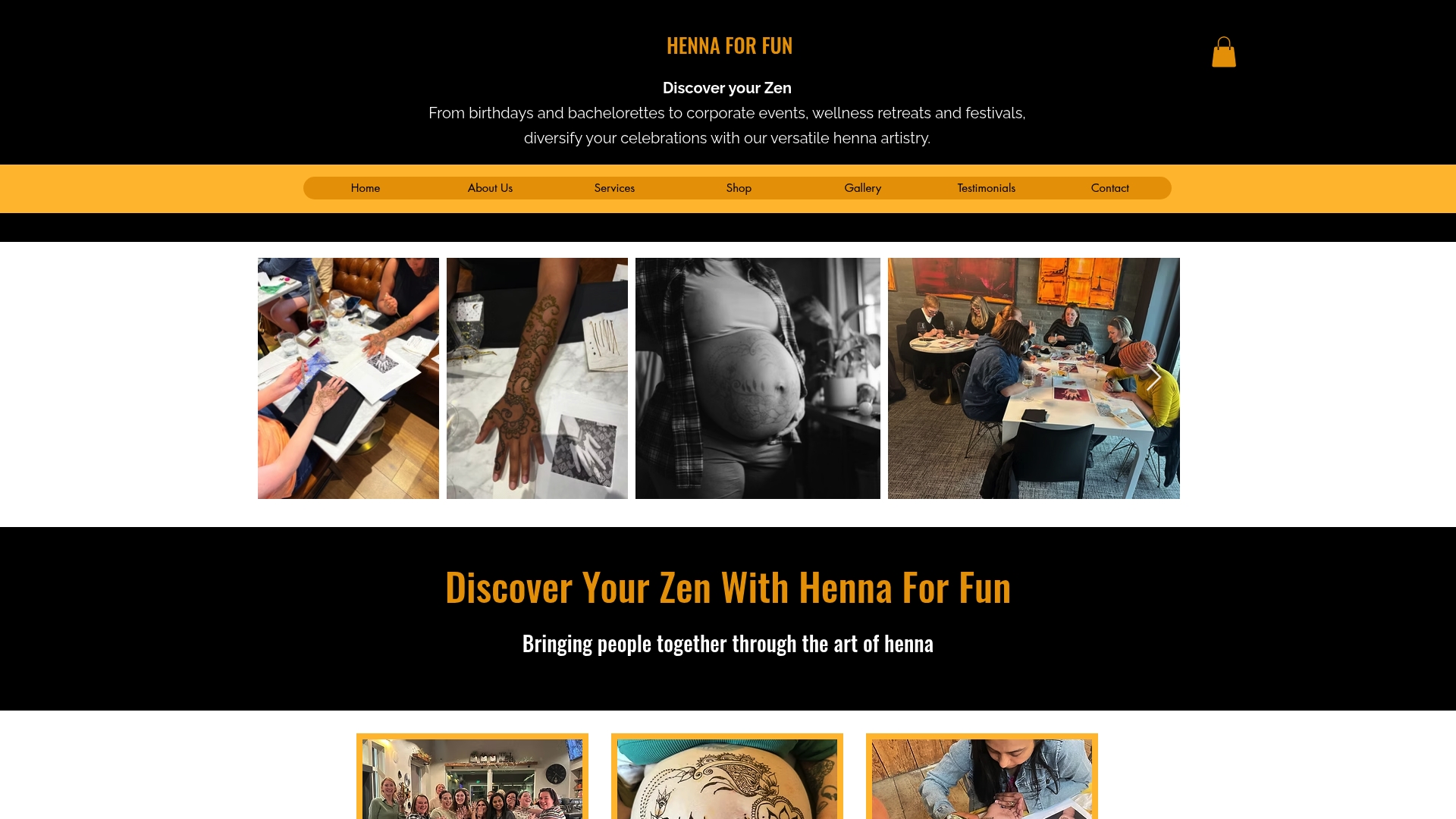
If you would like to see what else we offer, our services page lists our parties, workshops and events, and our calendar shows when we are out and about.
Beyond the party: learning henna as a family
Some families want more than a one-day activity. If the quinceañera, her mother or her friends want to learn the art, we teach private and group lessons: a 3-day course is $111, a 5-day course is $179, and a session on henna mixing and cone making is $99. Details are on our lessons page. To try it at home first, our step-by-step guide shows how to roll a henna cone, and you can also buy handmade henna cones or DIY henna stencils for a pre-party gathering with the court.
If you are curious how long people have decorated their skin with henna, the history of henna makes a good read for a family afternoon before the event.
FAQ
How long does quinceañera henna take?
A small design takes a few minutes, and detailed designs on the hands or arms take longer. The paste is usually left on for two to six hours. Plan the artist’s hours around how many guests want a design, and add time if the court is getting larger designs.
How long does the stain last?
The stain fades as the outer layer of skin sheds, so water, friction and sun shorten it. On the wrist or inner forearm, about two weeks of color is typical, while upper arms and shoulders fade sooner. The color is lightest at first and darkens over the next two to four days.
Do guests bring a gift to a henna party?
At a quinceañera, the henna is part of the party, so guests bring their usual gift for the birthday girl and nothing extra for the henna. If the henna is a separate pre-party hosted by the family, a small gift for the quinceañera is a kind gesture, but there is no fixed rule.
Is henna safe for teens and kids?
Plain henna paste, which stains reddish-brown, is the version people use for celebrations. Avoid anything that stains black or lists PPD, and patch test anyone with sensitive skin. For children, keep designs to the backs of hands, wrists and tops of feet, away from the face and eyes, and ask a doctor if a child has allergies or skin conditions.
Sources
Recommended
Comments