25 Male Henna Designs: Bold Patterns for Men
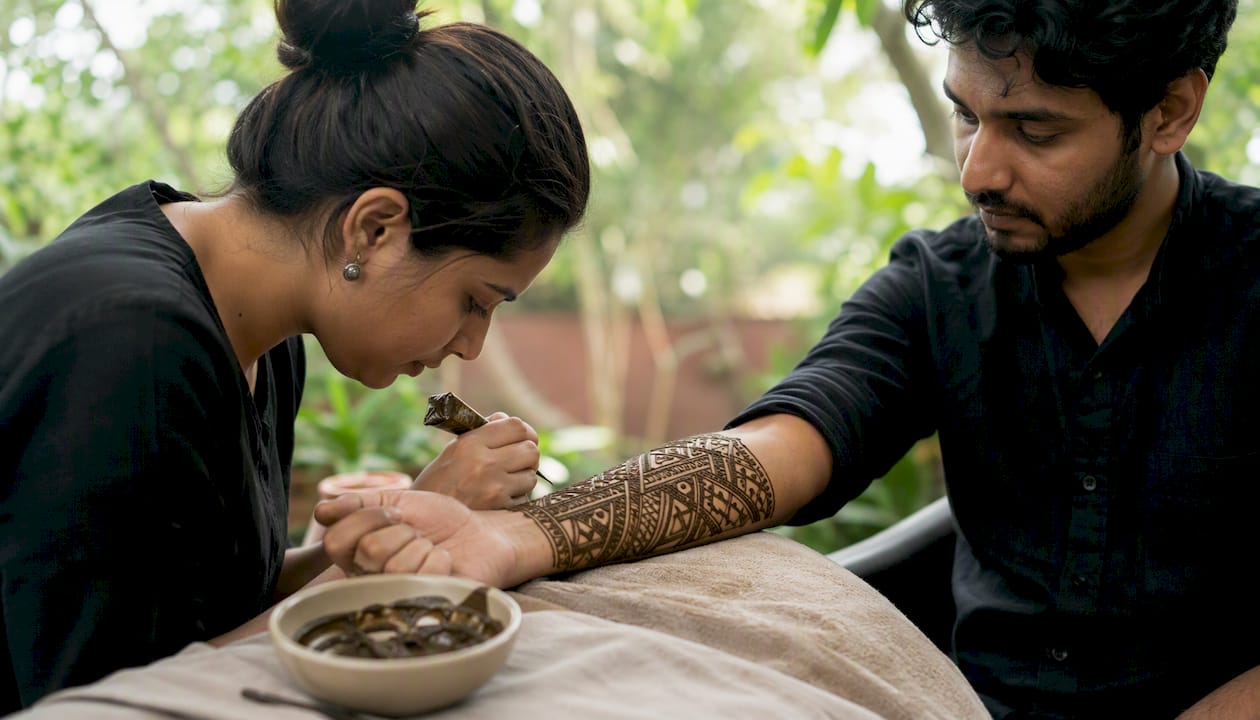
Male henna designs can be bold, minimal, and genuinely striking — and they’re easier to copy than you’d expect. Here’s how to move from inspiration to ink:
Browse the gallery below for 25 curated masculine designs across five placements (hands, forearms, chest, shoulders, wrists).
Copy one of the step-by-step templates in Section 5 — each is beginner-friendly and takes under an hour.
Book a private lesson or event with Hennaforfun to get expert guidance on masculine motifs in Washington state.
Natural henna is temporary, painless, and plant-based, which means you can experiment with bold geometric sleeves or a single wrist emblem without any permanent commitment. Henna tattoos for men range from ornate Indian-style patterns to stripped-back Arabian linework — the aesthetic flexibility is the whole point.
Key Takeaways
Bold, geometric, and minimalist male henna designs all work — the deciding factor is matching line weight and motif type to the placement, not the complexity of the pattern.
Point | Details |
Style families to know | Geometric, tribal, bold mandala, minimalist, and Arabic-linear are the five main masculine categories. |
Placement drives perception | Scale your design to the body part — a forearm sleeve reads intentional; an undersized wrist mark disappears. |
Safety first | Use only natural henna paste; avoid any product that stains black, which signals PPD and chemical burn risk. |
Stain timeline | Peak color develops 24 hours after removal; designs last 1–3 weeks depending on placement and aftercare. |
Hennaforfun | Offers private lessons in Kirkland, Bellevue, and Snohomish plus DIY kits for at-home practice across Washington. |
Table of Contents
What do male henna designs actually look like?
The short answer: nothing like the delicate floral patterns most people picture. Men’s henna — sometimes called mehndi in South Asian tradition — tends toward bold central motifs, thicker graphic lines, and deliberate negative space. The result reads more like a tattoo than a decoration.
Strong image-first search results confirm that men are looking for visual inspiration above everything else. The gallery below covers 25 designs across five placement zones. They are organized by style family so you can find your type fast.
Gallery: 25 masculine henna designs by placement
Hand and palm designs (1–8)
Central palm mandala — a bold eight-point star with thick radiating lines; fills the palm center; reads strong because the geometry is symmetrical and uncluttered.
Back-of-hand tribal wrap — angular chevrons from knuckles to wrist; Polynesian-inspired; works best on larger hands.
Finger band set — three stacked geometric bands on the index and middle fingers; minimal, modern, easy to replicate.
Knuckle accent dots — single dot clusters at each knuckle joint; the most minimal option in the gallery.
Arabic palm sweep — flowing vine-free linework from thumb base to wrist; Arabian style keeps it open and graphic.
Full palm geometric fill — interlocking triangles covering the entire palm; high-impact, festival-ready.
Half-hand cuff — geometric border that wraps from pinky to index base; sits like a glove cuff.
Single-finger emblem — a small compass or arrow on one finger; great first design for skeptics.
Forearm and sleeve designs (9–15)
Geometric forearm band — a 2-inch repeating diamond band around the mid-forearm; clean and symmetrical.
Half-sleeve tribal stripe — thick vertical lines with cross-hatching from wrist to elbow; Polynesian-inspired.
Full forearm mandala sleeve — central mandala at the wrist expanding into geometric fill toward the elbow; the showpiece of the gallery.
Minimalist arrow sleeve — a single bold arrow running the length of the forearm with small flanking marks; fine-line, modern.
Geometric patchwork sleeve — three separate motif patches (diamond, chevron, dot cluster) spaced along the forearm; looks intentional, not busy.
Arabic linear forearm — flowing script-adjacent linework without actual text; reads elegant and masculine.
Tribal armband — a thick band at the bicep-forearm junction; works as a standalone or as a sleeve anchor.
Wrist and cuff designs (16–19)
Geometric wrist cuff — interlocking rectangles forming a 1-inch band; the most requested beginner design.
Dot-and-dash cuff — alternating dot clusters and short lines; minimal, fast to apply.
Tribal wrist wrap — bold angular marks wrapping the full wrist; pairs well with watches.
Single-line wrist emblem — a small sun, compass, or rune-style mark on the inner wrist; subtle and personal.
Chest and shoulder designs (20–25)
Chest panel mandala — a large central mandala centered on the sternum; bold, ceremonial, photograph-ready.
Shoulder stripe — a thick geometric band running from the shoulder cap down the upper arm; reads like a tattoo sleeve starter.
Collarbone arc — a curved geometric line following the collarbone; minimal and striking in open-collar photos.
Shoulder blade motif — a single large tribal or geometric symbol on the upper back; strong for beach or event settings.
Chest-to-shoulder wrap — geometric linework connecting the chest panel to the shoulder stripe; the most ambitious design in the gallery.
Sternum emblem — a small compass, arrow, or geometric mark at the sternum center; the minimalist chest option.
Pro Tip: For downloadable masculine templates, the Menna Volume One collection includes 20 masculine-oriented patterns designed for festival and groom work — a solid starting point for artists and DIYers alike.
Design | Placement | Style | Difficulty |
Central palm mandala | Palm center | Geometric | Beginner |
Back-of-hand tribal wrap | Back of hand | Tribal/Polynesian | Intermediate |
Geometric forearm band | Mid-forearm | Geometric | Beginner |
Full forearm mandala sleeve | Wrist to elbow | Mandala/Geometric | Advanced |
Chest panel mandala | Sternum | Mandala | Advanced |
Tribal wrist wrap | Wrist | Tribal | Beginner |
Shoulder stripe | Shoulder to upper arm | Tribal/Geometric | Intermediate |
Which style families work best for masculine henna?
Five broad categories cover most of what men request: traditional dense mehndi, minimalist fine-line, tribal/Polynesian-inspired, geometric, and hybrid mixes. U.S. audiences are gravitating toward minimalist and hybrid patterns — less fill, more structure.
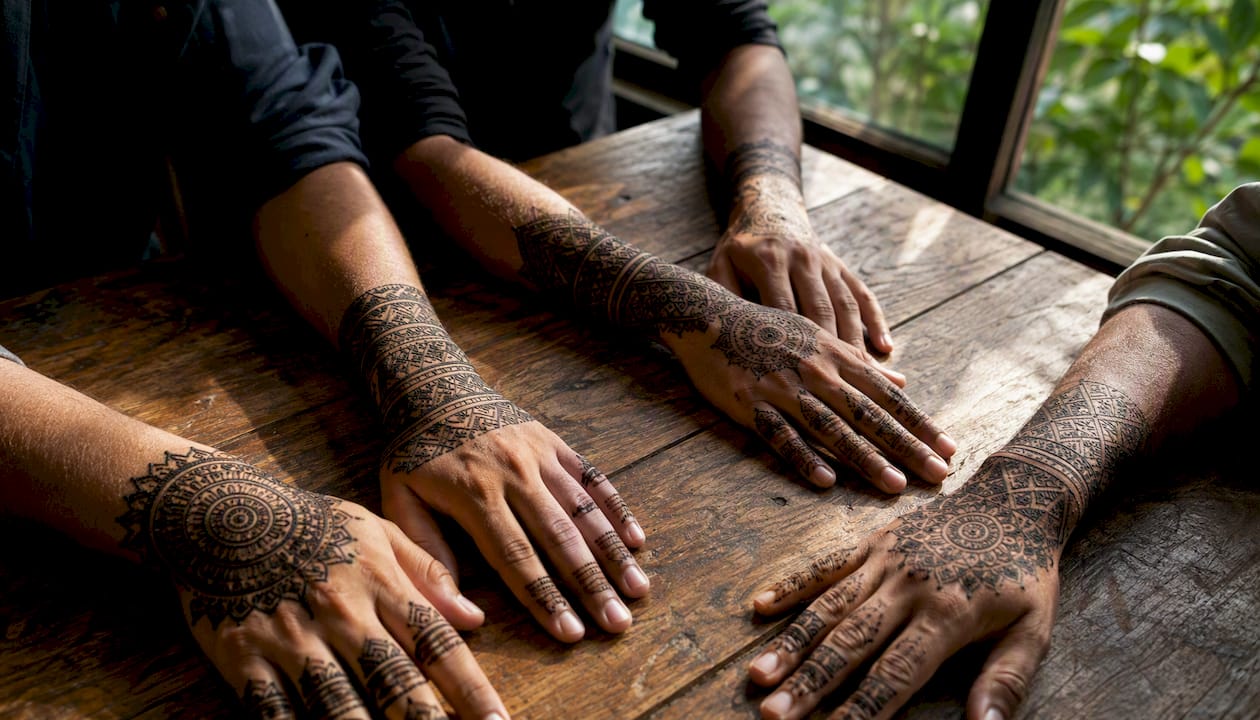
Geometric: Repeating triangles, diamonds, and interlocking shapes. High symmetry and zero floral elements make these read unambiguously masculine. Best placements: forearm bands, palm centers, wrist cuffs.
Tribal/Polynesian-inspired: Thick angular marks, bold fills, and directional lines. The weight of the linework does the heavy lifting. Best placements: shoulder stripes, forearm sleeves, armbands.
Bold-line mandalas: Central radial motifs with thick spokes and minimal interior fill. The key is keeping the center dense and the outer rings open. Best placements: palm center, chest panel, shoulder blade.
Minimalist/fine-line: Single motifs, arrow lines, or sparse geometric marks. These photograph well and feel modern. Best placements: inner wrist, single finger, collarbone arc.
Arabic-inspired linear: Flowing lines without floral fill — think calligraphic structure without the script. Best placements: forearm, back of hand, palm sweep.
A floral mandala can be transformed into a bold geometric design with those three adjustments alone.*
Where should you place henna for a masculine look?
Placement shapes perception as much as the design itself. A delicate pattern on the wrong spot reads decorative; the same pattern scaled up on a forearm reads intentional.
Palm center: High visibility, strong impact. Best for mandalas and geometric fills. Fades faster due to friction.
Back of hand: Visible in photos and conversation. Tribal wraps and Arabic sweeps work well here.
Full or half forearm sleeve: The most versatile masculine placement. Covers enough skin to tell a visual story.
Wrist cuff: Low commitment, high style. Works as a standalone or as a sleeve anchor.
Shoulder stripe/cap: Strong for events, beach settings, and photoshoots. Less visible in daily wear.
Chest panel: Ceremonial and photogenic. Best reserved for weddings, festivals, or intentional shoots.
Size | Coverage | Best for | Wear time |
Small | Single motif or finger band | First-timers, subtle looks | 1–2 weeks |
Medium | Wrist cuff + partial hand or forearm patch | Events, casual wear | 1–2 weeks |
Large | Full sleeve or chest piece | Weddings, festivals, photoshoots | 2–3 weeks |
Five beginner patterns you can copy step by step
These five patterns move from simplest to most involved. Each takes 20–60 minutes with a standard cone.
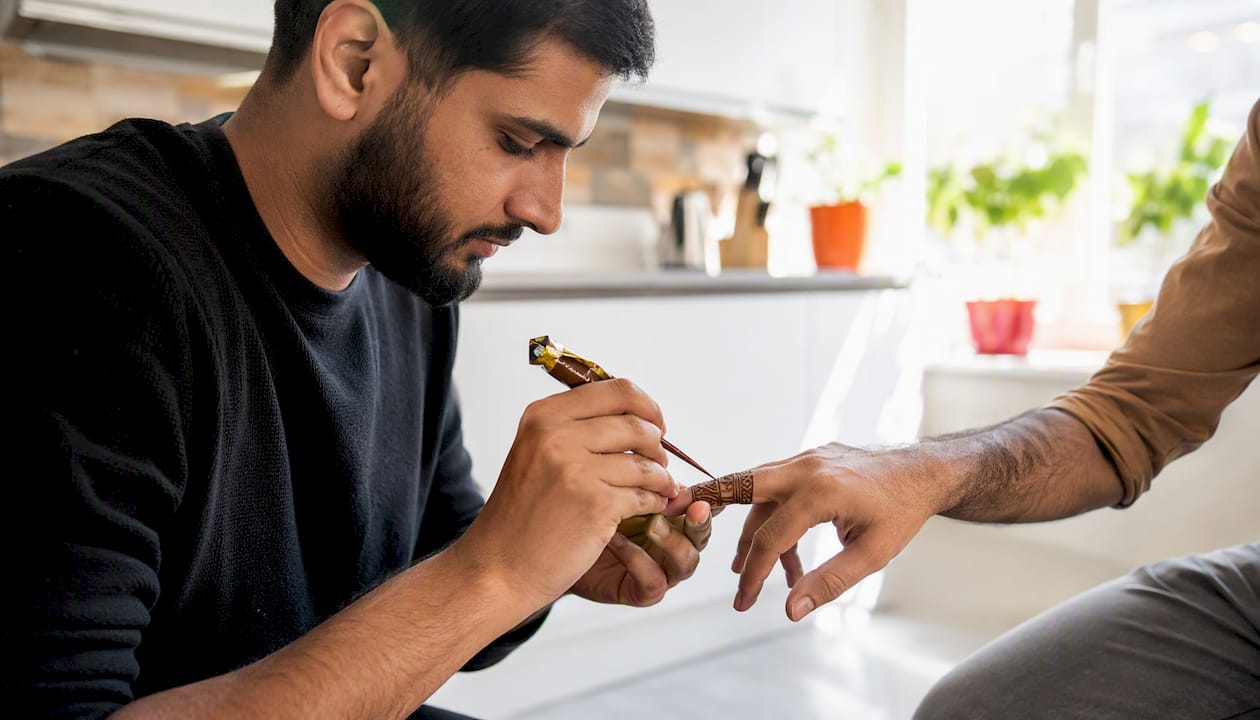
1. Finger bands with knuckle accents Draw three parallel horizontal lines around the middle finger using steady, even pressure. Add a small dot above each line at the knuckle. Let dry 30 minutes before touching.
2. Simplified central palm mandala Start with a small circle at the palm center. Add eight short spokes radiating outward. Connect the spoke tips with a second circle. Add a dot between each spoke at the outer ring. Total time: 25 minutes.
3. Geometric forearm band Draw two parallel horizontal lines 1.5 inches apart around the mid-forearm. Fill the space between them with repeating diamond shapes. Cap each diamond with a small dot. Clean, fast, and very copyable.
4. Tribal stripe wrist cuff Draw three thick vertical lines side by side on the outer wrist. Add short diagonal cross-hatches between each pair. Wrap the set with a thin horizontal border line top and bottom.
5. Single-line wrist emblem Sketch a simple compass rose or arrow at the inner wrist: four directional lines meeting at a center point, with small arrowheads on the north and south lines. Minimal, modern, and done in under 15 minutes.
For ready-made stencils that help you replicate these motifs cleanly, DIY henna stencils from Hennaforfun are a practical shortcut — especially for the mandala and geometric band patterns.
Pro Tip: Rest your cone hand against a stable surface (a table edge or your own knee) and move the skin, not the cone. Cone pressure should feel like writing with a gel pen — consistent, not squeezed.
Safe materials, staining timeline, and aftercare
Natural henna paste is made from Lawsonia inermis powder mixed with an acidic liquid (lemon juice or strong tea), sugar, and an essential oil like lavender or cajeput. That’s the whole ingredient list for a safe product. Men’s henna product lines confirm the market for male-targeted plant-based formulations, and the ingredient standard is the same whether you’re using body henna or hair henna: pure plant pigment, no synthetics.
What to use:
Pure natural henna powder (body-art quality, not hair-dye grade)
Lemon-sugar sealant to keep paste moist while it dries
Lavender or cajeput essential oil for color depth
Handmade henna cones or applicator bottles for clean lines
Black henna warning: Any product labeled “black henna” almost certainly contains PPD (para-phenylenediamine), a synthetic dye that causes chemical burns and permanent scarring. Natural henna stains orange-to-brown, never black. Avoid any paste that promises a black result, and always patch-test a new product on your inner arm 24 hours before a full application.
After removing the dried paste, avoid water on the design for at least 6 hours. Apply a thin layer of coconut or olive oil instead of washing. For full aftercare detail, the shower-after-henna guide covers exactly when water contact is safe and how to extend stain life.
How to wear traditional henna designs respectfully
The direct answer to “Is doing henna racist?”: henna has roots in South Asian, Middle Eastern, and North African cultures where it carries real ceremonial meaning. Wearing it respectfully means understanding that context, not avoiding it entirely.
Do:
Learn what a motif means before using it, especially for symbols tied to specific ceremonies (wedding, religious, or mourning traditions).
Credit the cultural origin when sharing photos — “inspired by South Asian mehndi tradition” takes five seconds and matters.
Ask your henna artist about the background of the design they’re applying. A good artist will know and will appreciate the question.
Support artists from the cultures that originated the practice.
Don’t:
Reproduce sacred or ceremonially specific symbols as casual decoration without understanding their weight.
Claim cultural ownership or expertise you don’t have.
Treat a deeply meaningful motif as a novelty accessory.
The geometric and tribal-inspired patterns in this gallery draw from broad visual traditions rather than ceremony-specific symbols, which makes them lower-stakes starting points. When in doubt, ask your artist. That conversation is part of the experience.
How Hennaforfun can help you get the look
Hennaforfun offers private henna lessons in Kirkland, Bellevue, and Snohomish, Washington — a direct path to learning masculine design techniques from an experienced artist rather than guessing from a tutorial. Lessons cover cone handling, line control, and how to adapt traditional motifs into bolder, more graphic compositions.
For events, Hennaforfun provides on-site henna artists for parties, corporate workshops, and group gatherings across the Seattle metro area. The service works well for grooms, groomsmen groups, or any event where a henna station adds a memorable, interactive element.
What’s available:
Private and group lessons (Kirkland, Bellevue, Snohomish)
Event henna artists for parties, corporate events, and festivals
DIY henna kits for at-home practice
Handmade cones for clean, consistent application
Pregnancy henna services for expectant parents
For readers who want to practice before booking a session, the DIY kit includes everything needed to attempt the beginner patterns in Section 5. For those ready to book, the services and events page lists current options and availability.
Why bold and minimal both work — and what most men get wrong
The conventional wisdom says men should stick to “simple” henna. That framing undersells the range. A full forearm mandala sleeve is not simple, but it reads unmistakably masculine when the linework is thick and the fill is geometric rather than floral. The real variable isn’t complexity — it’s line weight and motif type.
What most men get wrong is choosing a design that’s too small for the placement. A tiny wrist motif on a large hand disappears. A medium geometric band on the same hand looks deliberate. Scale to the body part, not to your comfort level with commitment — the whole point of henna is that it fades.
The other underrated move: going monochromatic and graphic on the chest or shoulder for a photoshoot or event, then letting it fade naturally. The temporary nature is a feature, not a limitation. Men who treat henna like a trial run for a tattoo concept get the most out of it — they use the stain to test placement, sizing, and style before committing to ink.
Hennaforfun makes masculine henna easy to try
Getting a masculine henna design right the first time is much easier with the right tools or an experienced artist in your corner. Hennaforfun serves clients across the Seattle metro area — Bothell, Lynnwood, Snohomish, Edmonds, and beyond — with private lessons for anyone who wants to learn the craft and event bookings for groups who want a professional on-site.
For DIYers, the complete starter kit includes natural henna paste, applicator cones, and step-by-step guidance — everything in the beginner patterns section, ready to go. For readers who want a professional to handle the design, book a session or check current availability at Hennaforfun.
Sources
Recommended
Comments