Henna Practice Sheets for Beginners and Hobbyists
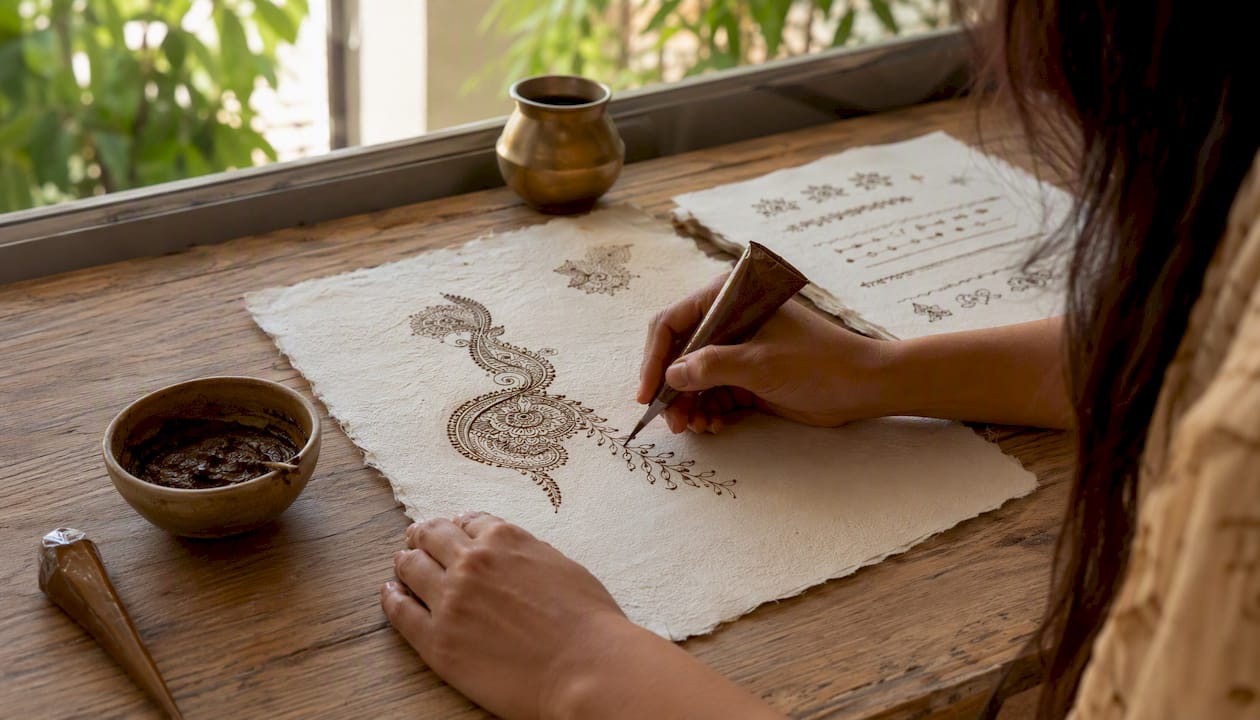
The fastest way to start is to download a free PDF and print it today. Free single-page henna practice sheets are available at Hennapage, which offers a classic patterns PDF covering dots, lines, paisleys, and check fills. For a structured beginner pack, Hennaforfun’s DIY Henna Kit bundles practice sheets with handmade cones so you practice with real paste from day one.
Where to get printable henna practice sheets right now:
Free PDF downloads: hennapage.com patterns PDF, free design galleries with 200+ motifs at ShopBeachcombers
Paid beginner packs: multi-page eBooks (typically 36 pages in A4 and US Letter formats) from specialty henna shops
Reusable practice books: wipe-clean glossy A3 books designed for real cone use, available from Hennaya Naturals
Starter kits: Hennaforfun’s DIY Henna Kit (cones plus practice sheets bundled)
Best file type for printing: PDF. It holds layout at any scale, prints cleanly on standard 8.5×11 paper, and most home printers handle it without resizing. PNG or JPG works better if you’re loading sheets onto a tablet for digital tracing.
Pro Tip: Print two copies of every sheet: one for tracing with a plastic overlay, one for freehand attempts. Comparing them side by side shows exactly where your hand control breaks down.
Key Takeaways
Printable henna practice sheets build real skill only when paired with structured element-first drills, real paste, and a consistent weekly schedule.
Point | Details |
Start with a PDF download | Free PDFs from hennapage.com cover core elements; print two copies for tracing and freehand comparison. |
Drill one element per session | Isolating dots, paisleys, or scallops per session builds automatic muscle memory faster than copying full designs. |
Practice 3× weekly, 10–30 minutes | A four-week schedule moving from lines to motifs to compositions produces measurable improvement. |
Avoid black henna products | Natural paste stains brown; any product promising a black stain likely contains PPD and is unsafe for skin. |
Hennaforfun’s DIY Kit | Bundles handmade cones with practice sheets so beginners practice with real paste from the first session. |
Sourced resources for practice sheets and guides
Henna patterns PDF (hennapage.com) — free downloadable PDF covering core henna elements and drill patterns
How practicing on paper sharpens mehndi designs (Mehndistan) — instructor-backed rationale for structured sheet practice
Reusable Henna Practice Book (Hennaya Naturals) — 23 wipe-clean A3 pages for repeated cone practice
Beginner henna tattoo guide (HennaKing) — covers stencils, templates, tip technique, and drying times
Mehndi elements practice drills (MyTribe) — instructor-level guidance on element isolation and repetition
Henna drills and practice tips (HennaArt blog) — practical advice on paste practice and muscle memory
Hennaforfun DIY Henna Kit — starter kit with cones and practice sheets for US learners
Table of Contents
What formats of henna practice sheets should you use?
Not every format suits every stage of learning. Choosing the wrong one early wastes time.
Single printable PDFs are the entry point. They’re free or cheap, print in seconds, and let you repeat a drill as many times as you need by reprinting. The downside is paper waste if you practice daily.
Multi-page eBooks give you a structured curriculum in one file. A well-built beginner eBook typically includes guided stroke exercises, practice boxes, and both A4 and US Letter sizing so printing is straightforward wherever you are. These suit learners who want a clear progression rather than a scattered collection of single sheets.
Reusable wipe-clean practice books solve the paper waste problem. A reusable mehndi practice book with 23 glossy A3 pages lets you apply real henna paste, wipe it clean, and repeat the same drill hundreds of times. Classroom instructors favor these because students can practice with actual cones without burning through reams of paper.
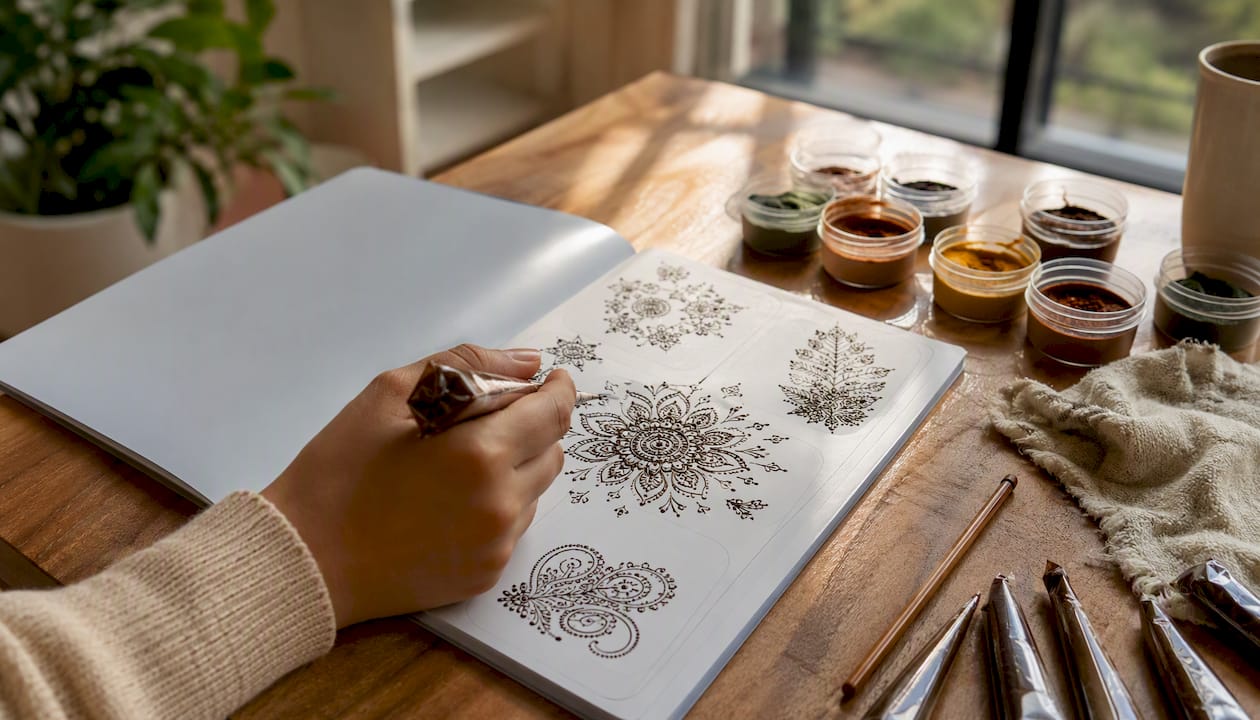
Stencils and templates serve a different purpose. Stencils speed up symmetry practice early on; templates are better for training freehand after you’ve done enough tracing to internalize a shape. The HennaKing beginner guide explains this transition clearly.
Physical kit inserts come with starter kits and are pre-sized for the cones included, which removes guesswork about cone pressure and tip size.
Pro Tip: If you’re selling henna prints or practice supplies at local events, a craft fair vendor setup pairs well with printed sample sheets as display pieces.
What core drills should every practice sheet include?
A sheet that only shows finished designs is nearly useless for building skill. The foundational henna elements that every drill sheet should cover are:
Dots: the most basic pressure test; consistent dot size reveals cone control immediately
Straight lines: horizontal, vertical, and diagonal; exposes shaky wrist and uneven flow
Scallops and humps: the building block of borders and petal edges
Swirls and spirals: train smooth wrist rotation and consistent line weight
Paisleys: combine a teardrop body with a curved tip; the single most repeated motif in henna
Lotus petals and leaves: introduce symmetry and layering
Check and grid fills: test spacing consistency and patience
Mastering these units matters because every complex bridal or full-hand design is built from combinations of them. A sheet that isolates each element into its own practice row forces you to confront the mechanics, not just copy a pretty photo.
Pro Tip: Pick one element per session and fill an entire page with it. Boring? Yes. Effective? Completely. Artists who isolate elements this way build automatic muscle memory far faster than those who jump between motifs.
How do you use practice sheets to actually build skill?
Structure matters more than time. A 15-minute focused session beats an hour of aimless copying.
Warm up for 5 minutes. Fill one row each of dots, straight lines, and scallops. This primes hand-eye coordination and tells you immediately if your cone tip or paste consistency needs adjusting before you commit to motifs.
Spend 10–15 minutes on one motif. Choose a single element from your sheet, a paisley or a lotus petal, and repeat it across the page. Vary the size deliberately: small, medium, large. This builds spatial awareness alongside muscle memory.
Attempt a short composition for the last 5 minutes. Combine two or three elements you’ve drilled into a small border or corner piece. No reference photo. Work from memory.
Realistic schedule: Three sessions per week at 10–30 minutes each is enough to see measurable improvement within four weeks. Week one focuses on lines and dots. Week two adds paisleys and scallops. Week three introduces leaves and lotus shapes. Week four combines them into small compositions.
Tracing vs. freehand: Start with a clear plastic overlay on your printed sheet and trace directly with a cone. This builds the correct wrist path without the anxiety of a blank page. After two or three traced attempts, flip to a blank sheet and go freehand. The gap between the two versions shows you exactly what to drill next.
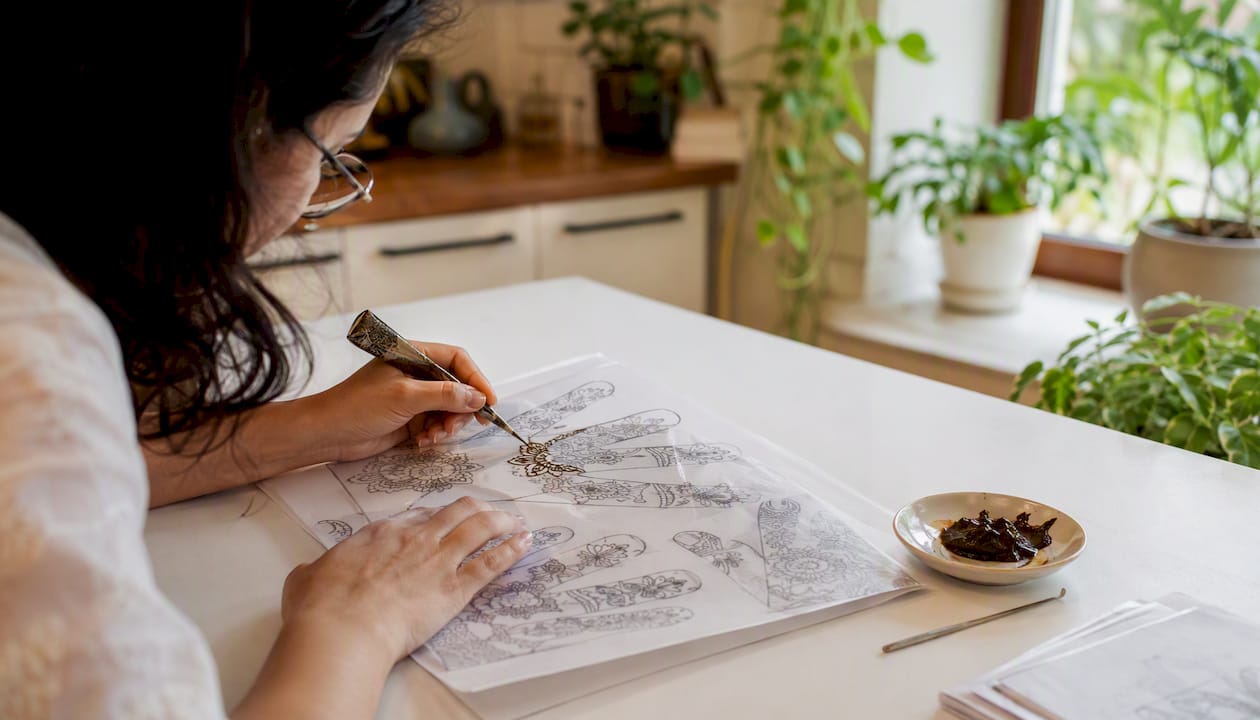
Practicing with real henna paste matters more than most beginners expect. Paste has drag, flow, and drying characteristics that a pen cannot replicate. Conditioning your hand to real paste from the start means the muscle memory you build on paper transfers directly to skin.
Pro Tip: Before moving a design to skin, practice it five times on paper. If it looks clean on the fifth attempt, your hand is ready. If it still wobbles, do five more.
Which printable templates give you the most practice value?
Not all templates are equal. Prioritize these:
Full-hand outlines: the most useful single template; shows you how a design fills real proportions
Finger chain grids: isolates the narrow, curved surface you’ll actually work on most
Foot outlines: slightly different proportions than hands; worth practicing separately
Mandala center circles: trains radial symmetry, the hardest spatial skill in henna
Small motif repeat sheets: rows of blank boxes sized for one motif each
Use at least 24 lb paper if you’re tracing with a cone directly on the sheet; lighter paper buckles under paste moisture. For overlay practice, a sheet of transparency film or a clear plastic sleeve from any office supply store works perfectly.
For digital tablets, crop individual motif rows from a multi-page PDF using Adobe Acrobat or a free tool like Smallpdf, then import them as separate layers so you can trace and reset without reprinting.
What should you expect from paid packs and starter kits?
Format | Skill target | What’s included | Value |
Free single PDF | Beginner | 1–4 pages, basic motifs | Zero cost; limited progression |
Paid eBook (PDF) | Beginner to intermediate | 19–36 guided pages, stroke drills, motif sheets | One-time purchase, printable unlimited times |
Reusable practice book | All levels | 23 wipe-clean A3 pages, cone-ready surface | Higher upfront cost; saves paper long-term |
Starter kit with cones | Beginner | Practice sheets, cones, stencils, basic instructions | Best for learners who want everything in one box |
A good paid pack includes sample pages or a downloadable preview before you buy, progressive drills that move from strokes to motifs to compositions, and instructor notes explaining what each exercise targets. A 19-page classroom-tested worksheet pack on Teachers Pay Teachers is one example of what a structured beginner PDF looks like.
Buy a kit when you want to practice with real paste immediately and don’t want to source cones separately. Hennaforfun’s DIY Henna Kit includes handmade cones alongside practice materials, which removes the guesswork of matching cone type to sheet size.
Pro Tip: Check that any paid pack specifies both A4 and US Letter page sizes. A pack formatted only for A4 will print with cut-off margins on a standard US printer unless you manually resize it.
Safety guidance and quick fixes for common practice problems
Black henna is not henna. Products labeled “black henna” or “black mehndi” almost always contain para-phenylenediamine (PPD), a chemical dye that causes severe allergic reactions, chemical burns, and permanent scarring. Natural henna is always brown to dark green in paste form and stains orange to dark brown on skin. If a product promises a black stain within hours, do not use it on skin.
Ingredient check: Read the full ingredient list before using any cone. Natural henna paste contains henna powder, water, lemon juice, sugar, and sometimes essential oils like lavender or eucalyptus. Any unfamiliar chemical name warrants a patch test on the inner forearm 24 hours before full application.
Common practice problems and fixes:
Broken or skipping lines: paste is too thick or the tip is clogged; warm the cone briefly in your hands and clear the tip with a pin
Paste too runny: the cone was stored warm or the mix is over-hydrated; refrigerate for 20 minutes before use
Smudging: you moved the design before it dried; let paste sit at least 20–30 minutes before touching, longer in humid conditions
Uneven pressure: your grip is too tight; hold the cone like a pen, not a squeeze bottle, and let wrist movement do the work
For drying and stain guidance once you move from paper to skin, how long to leave henna on covers timing and sealing techniques in detail.
Why do structured drill sheets build henna skill faster?
Practicing on paper with structured sheets forces focus on mechanics: pressure, line weight, and flow. Beginners who copy finished photos skip this entirely and hit a ceiling fast because they never learned to control the cone, only to mimic an outcome.
The progression that works is element first, then motif, then composition. Isolating a single paisley and repeating it until it’s automatic gives you a building block you can place anywhere. Jumping straight to full-hand layouts before that automation exists produces designs that look copied rather than composed.
“Mastery of complex full-hand or bridal layouts comes from repeated isolation of single elements until drawing them becomes automatic — then combining them rhythmically into larger compositions.” — MyTribe Mehndi Training Academy
Practicing with real paste accelerates this further. Henna paste conditions the hand to the specific drag and flow of the medium in a way that pens simply cannot. Artists who make the switch from pen to cone practice report that their line control on skin improves noticeably within weeks.
A note on why these drills work from someone who teaches them
The drills in Hennaforfun’s practice materials come directly from the exercises used in private lessons and group workshops in the Kirkland, Bellevue, and Snohomish area. Students who arrive having done even two weeks of structured sheet practice progress noticeably faster than those who haven’t, because the cone already feels familiar. Printable sheets aren’t a shortcut around real instruction; they’re what makes instruction land faster when you get there. For learners who want that instructor feedback alongside their home practice, private henna lessons are available in person.
Hennaforfun’s practice kits and worksheets get you started right
Skip the scattered free-download hunt. Hennaforfun’s DIY Henna Kit gives you handmade cones and practice sheets in one package, so your first session uses real paste on real drills instead of a ballpoint pen on a random printout. That difference in feel is exactly what builds transferable muscle memory.
For learners who want guided progression beyond a kit, henna classes for beginners walks through the same structured drill sequence used in Hennaforfun’s in-person workshops. And if you’re ready for one-on-one feedback, private lessons in Kirkland, Bellevue, and Snohomish are available to book now.
Sources
Recommended
Comments