Henna on Dark Skin: How It Looks and How to Go Darker
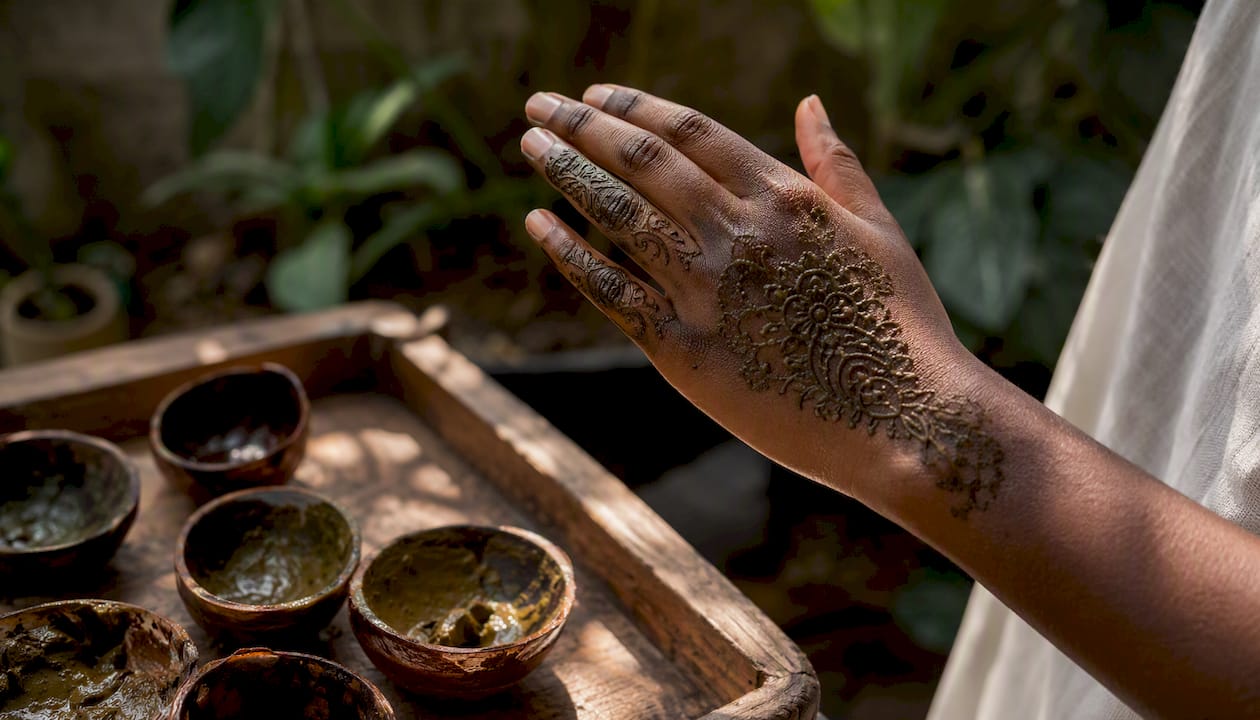
Yes, natural henna absolutely shows on dark skin. The stain typically develops into deep burgundy, reddish-brown, or mahogany tones, and community members with darker complexions confirm it’s visible and beautiful when done right. The key is using fresh, body-art-quality (BAQ) henna and leaving the paste on long enough for the dye to fully absorb.
What to expect right after removal: a bright orange stain. That’s normal. Over the next few days, lawsone (the active dye in henna) oxidizes against your skin’s natural undertones, deepening into its final reddish-brown or burgundy shade. On darker skin, the contrast is real and striking, especially with the right technique.
Will it show? Yes. The stain reads as a warm, dark reddish-brown against deeper skin tones.
How visible? Bold fills and thick-lined designs create the strongest contrast.
Top tip for darker results: Leave the paste on for at least 6–8 hours, keep it warm, and skip water for 12–24 hours after removal.
Key Takeaways
Natural henna on dark skin develops into deep burgundy or reddish-brown tones over 24–72 hours, and the stain’s depth depends almost entirely on paste quality, leave-on time, and dry aftercare.
Point | Details |
Henna does show on dark skin | Expect deep burgundy to reddish-brown tones; peak color arrives at 48–72 hours. |
BAQ henna is non-negotiable | Fresh, body-art-quality powder produces measurably richer stains than low-grade alternatives. |
Leave on 6–12 hours, stay dry | Longer leave-on time plus avoiding water for 12–24 hours after removal deepens final color. |
Avoid black henna and PPD | Black henna contains PPD, which the FDA flags as unsafe; it can cause burns and lasting sensitization. |
Hennaforfun for pro results | Book a Whenna Event, private lesson, or order handmade cones for reliable dark-skin staining. |
Table of Contents
How henna on dark skin actually works
Henna is a transparent stain, not a pigment sitting on top of your skin. Lawsone, the dye molecule in the henna plant, binds to keratin proteins in the outer skin layer. Your skin’s own color becomes the canvas. On lighter skin, the reddish-brown stain contrasts sharply against a pale base. On darker skin, the stain develops into deep burgundy or reddish-brown hues, which read as a warm, rich tone against the skin’s natural depth.
Undertone matters more than most people realize. Warm undertones (golden, olive, or amber) tend to push the final stain toward a deeper, richer red-brown. Cooler undertones may produce a slightly more muted result, though the difference is subtle. Either way, the stain is visible.
The color progression follows a predictable arc: fresh orange immediately after removal, then a gradual deepening over the following days as oxidation continues. Peak color typically arrives within a couple of days.
Pro Tip: BAQ (body art quality) henna powder is the single biggest variable in stain depth. Low-quality or old powder has degraded lawsone content, which means a weaker stain regardless of how long you leave it on. Fresh, finely sifted BAQ henna is non-negotiable for richer results on darker skin.
How to get a darker, richer stain on dark skin
Getting a deep stain on darker skin isn’t complicated, but it does require doing several things right at once. Here’s what actually moves the needle.
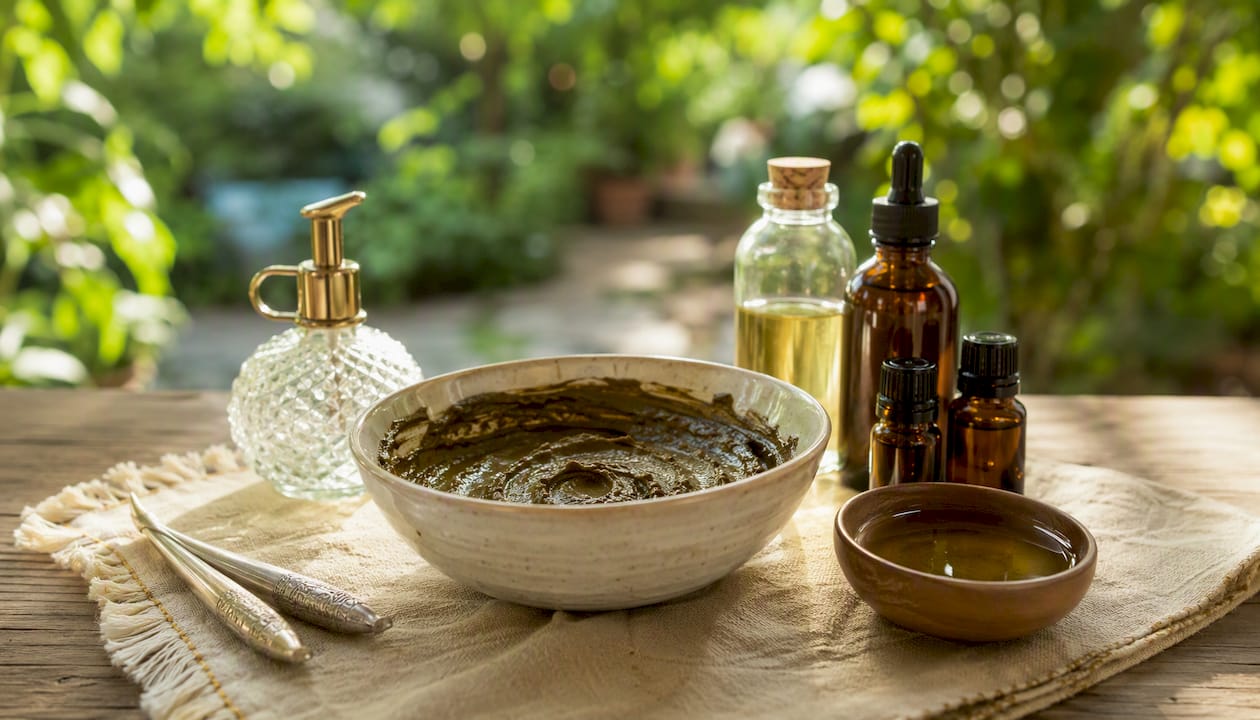
Start with fresh BAQ henna. Crop year and sift quality directly affect lawsone content. Older powder or low-grade henna simply won’t stain as deeply, no matter what else you do. Look for henna labeled body art quality with a recent harvest date.
Mix for maximum dye release. Slightly acidic liquids like lemon juice or a mix of lemon juice and strong brewed tea help activate lawsone. Adding a few drops of essential oils, particularly cajeput, lavender, or eucalyptus, speeds dye release. Mix your paste the night before application and let it rest covered at room temperature for 8–12 hours. This “dye release” window is when the paste goes from greenish to a darker olive-brown, signaling it’s ready.
Leave it on longer than you think. Six hours is a reasonable minimum. Eight hours is better. Overnight application (8–12 hours) consistently produces the deepest stains, especially on hands and forearms. Check out how long to leave henna on skin for a full breakdown of timing by body location.
Warmth is the most underrated factor in henna staining. Keeping the paste moist and the skin warm during application significantly accelerates dye release and deepens the final color. A cool room or drafty space works against you.
Seal the paste. Once the paste starts to dry (usually 20–30 minutes in), apply a sugar-lemon sealant with a cotton ball. This keeps the paste from cracking and falling off, maintaining contact with the skin and moisture in the paste. Wrap loosely with medical tape or a breathable fabric wrap if you’re sleeping with it on.
After removal, stay dry. Remove dried paste by scraping or rubbing with a small amount of coconut or olive oil. No water. Avoiding water for several hours up to a day after removal is one of the most effective steps for deepening the final color.
Pro Tip: Never use black henna or any paste containing PPD (paraphenylenediamine). Always patch test a small amount of any new henna paste on your inner wrist 24–48 hours before a full application.
Step-by-step application for maximum contrast
Exfoliate lightly 24 hours before. A gentle scrub removes dead skin cells and gives the dye a fresher surface to bind to. Don’t exfoliate the same day or you’ll irritate the skin.
Clean and dry the skin. No lotion, sunscreen, or oil on the skin before application. These create a barrier that blocks dye absorption.
Patch test. Apply a small amount of paste to your inner wrist. Wait 24–48 hours and check for redness, itching, or swelling before proceeding.
Load your cone and test the flow. Paste should flow smoothly without air bubbles. Consistency should resemble thick toothpaste. Too thin and lines bleed; too thick and the paste clogs.
Apply with steady, even pressure. For dark skin, thicker lines and filled motifs read better than ultra-fine filigree. Keep the cone tip close to the skin for precision.
Let the paste dry partially, then seal. After 20–30 minutes, dab on a sugar-lemon sealant. Reapply every hour if possible.
Leave on for 6–12 hours. Use warmth: sit near a heater, use a hair dryer on low from a distance, or simply stay in a warm room.
Remove without water. Scrape or rub off dried paste using a few drops of coconut oil. Buff gently. Apply a thin layer of oil to the stained area.
Avoid water for 12–24 hours. This is the aftercare step most people skip. It makes a measurable difference in final color depth. For more on this, showering after henna covers exactly when it’s safe to get the area wet.
Designs and placements that show best on dark skin
Choosing the right design is as important as the application technique. Bold fills, thick outlines, and negative-space motifs create the strongest visual contrast on darker skin tones. Fine filigree and delicate single-line patterns can get lost against deeper skin.
Bold filled motifs: Mandalas, paisley fills, and geometric blocks with solid shading show up clearly. The filled areas catch light differently than the skin, creating visible depth.
Negative space designs: Leaving skin exposed within a heavily outlined pattern creates contrast in reverse. The dark skin becomes part of the design.
Thick outlines: Any motif with outlines 2mm or wider reads well. Very thin lines tend to fade into the skin’s natural tone.
Placement: Palms and inner forearms stain the darkest because the skin is thinner and the keratin layer more receptive. Hands, wrists, and the inner arm are the most reliable spots for visible, long-lasting color. Shoulders and the back of the neck work well for photography.
Metallic accents: Pairing henna with gold or silver body jewelry, metallic temporary tattoos, or shimmer powder around the design dramatically increases visual impact in photos.
Occasion-specific ideas: For everyday wear, simple wrist cuffs or finger designs. For weddings, full-hand bridal mehndi with bold fills. For maternity sessions, large belly mandalas with flowing vine motifs work beautifully. Hennaforfun’s pregnancy henna services are specifically designed for this kind of occasion.
DIY henna stencils are a practical shortcut for creating bold, even fills without freehand skill.
How long henna lasts on dark skin
The stain’s lifespan depends on body location, skin type, and aftercare. Here’s the general timeline:
Milestone | Timeframe | What to do |
Fresh removal | 0–2 hours | Orange stain; apply oil, avoid water |
Color deepening | 24–48 hours | Keep dry, no exfoliation, apply oil daily |
Peak color | 48–72 hours | Stain at its darkest; ideal for photos |
Gradual fading begins | Days 4–7 | Moisturize with coconut or olive oil |
Stain mostly faded | Days 10–14 | Natural exfoliation removes remaining color |
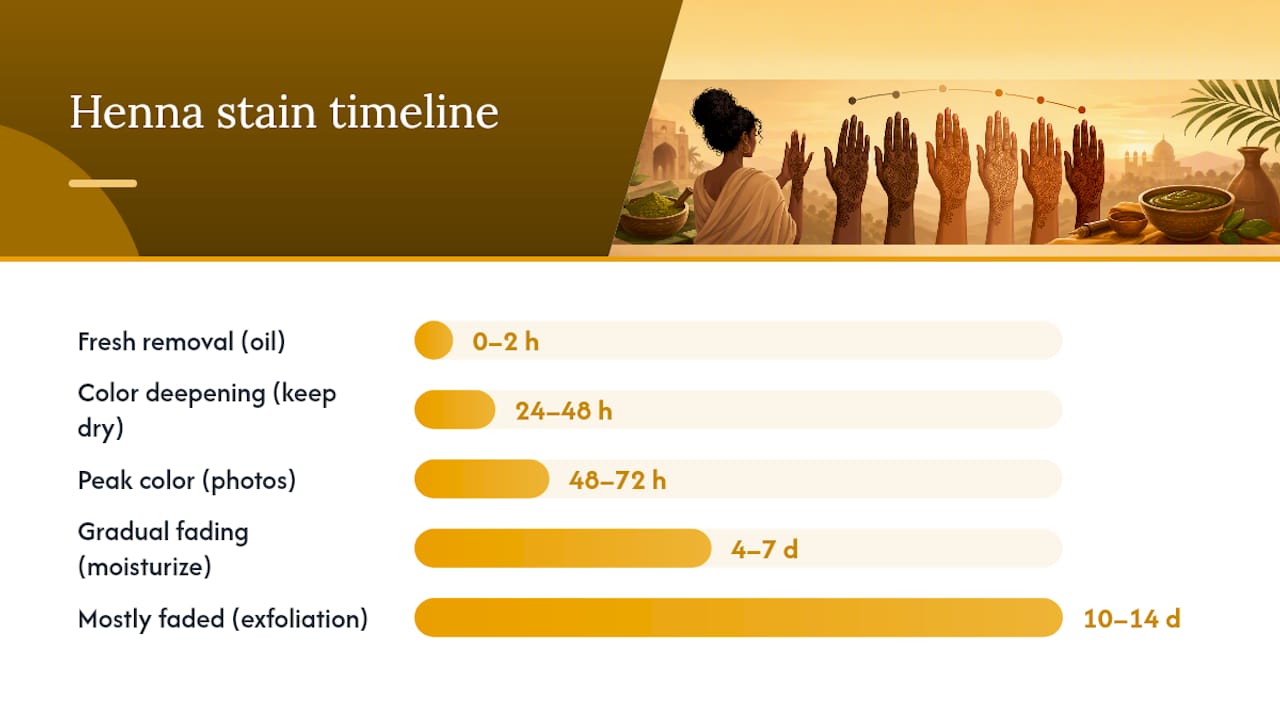
Palms and inner hands tend to hold color the longest, often 10–14 days, because that skin is thicker and renews more slowly. Legs and areas that see frequent friction or washing fade faster, usually within 7–10 days.
Aftercare do’s and don’ts:
Do apply coconut, mustard, or olive oil daily to slow fading.
Do keep the area moisturized to reduce natural exfoliation.
Don’t swim in chlorinated water or soak in a bath during the first week.
Don’t scrub the stained area with exfoliating products.
Don’t apply lotion with alcohol, which strips the stain faster.
Specific aftercare steps confirm that removing paste without water and avoiding chlorine are the two most impactful habits for longevity.
Safety, black henna risks, and cultural notes
The black henna problem
“Black henna” is not henna. It’s a chemical paste that often contains PPD (paraphenylenediamine), an industrial dye used in hair color. Natural brown henna is safe for body art; black henna containing PPD is not. PPD can cause severe chemical burns, blistering, and permanent sensitization, meaning future exposure to PPD (in hair dye, for example) can trigger a serious allergic reaction. The FDA has flagged PPD-containing henna products as unsafe for skin use.
Feature | Natural (brown) henna | Black/chemical henna |
Color result | Reddish-brown to burgundy | Near-black |
Key ingredient | Lawsone from henna plant | PPD or other chemical dyes |
FDA safety status | Generally recognized as safe for skin | Flagged as unsafe for skin use |
Allergy risk | Low (patch test still recommended) | High; can cause burns and sensitization |
Why some salons avoid henna
Liability is the main reason. Allergy reactions, even from natural henna, do occur. Salons that aren’t trained in proper mixing and patch-test protocols sometimes avoid henna entirely to sidestep that risk. This is also why sourcing from a knowledgeable artist or supplier matters.
Cultural sensitivity
Henna has deep roots in South Asian, Middle Eastern, and North African traditions, where specific designs carry ceremonial meaning. Bridal mehndi patterns, for example, carry cultural significance beyond decoration. If you’re drawn to traditional designs, taking a moment to understand their origin is a respectful practice. Hennaforfun’s private lessons include cultural context alongside technique.
Pro tips from a practicing henna artist
These are the details that separate a mediocre stain from a great one.
Heat management at events. At Whenna Events, artists use a hair dryer on low heat, held 12–15 inches from the skin, to speed dye release between clients. A warm room (above 75°F) does the same thing passively. Cold environments slow dye release noticeably.
Cone freshness check. Squeeze a small amount onto a paper towel before starting. Fresh paste is olive-green to dark brown. If it’s gray or smells off, it’s past its prime and won’t stain well.
Quick-dry hack for events. After sealing with sugar-lemon, a brief pass with a hair dryer on low sets the seal without drying the paste too fast. This lets you move to the next client without the first person’s design smearing.
Essential oil ratio. A few drops of cajeput or eucalyptus oil per tablespoon of paste is enough. More is not better; too much essential oil can irritate sensitive skin.
Pro Tip: For the deepest possible stain, mix your paste the night before, let it dye-release overnight, apply in a warm room, seal with sugar-lemon, wrap loosely, and sleep with it on. That single overnight application consistently outperforms a rushed 2-hour session.
For hands-on guidance, Hennaforfun’s henna stain depth guide covers the full mixing and aftercare process in detail.
What I’ve learned working with darker skin tones
Working with clients across a range of skin tones at Whenna Events and private sessions has reinforced one thing consistently: darker skin produces some of the most striking henna results when the technique is right. The warm reddish-brown against deep skin tones has a richness that lighter skin simply can’t replicate.
The most common question I hear is whether the stain will even show. It will. The second most common concern is getting it dark enough. That comes down almost entirely to paste quality, leave-on time, and staying dry after removal. Clients who follow those three steps reliably walk away with results they’re proud of.
For anyone who wants a professional application at a pregnancy celebration, a corporate event, or a private session, Hennaforfun’s services page has the full list of what’s available.
Hennaforfun brings professional henna to your event or doorstep
If you want guaranteed results on darker skin without the trial and error, Hennaforfun’s artists bring the right paste, the right technique, and years of experience directly to you. Whether it’s a Whenna Event at a winery or private venue, a maternity session, or a corporate workshop, every application uses fresh BAQ henna mixed for maximum dye release.

Prefer to practice at home? Hennaforfun’s handmade henna cones are made fresh and ready to use, and the DIY henna kits include everything a beginner needs to get started. For structured skill-building, private lessons cover mixing, application, and design selection with one-on-one feedback. Book a session or browse products at Hennaforfun.
Sources
Recommended
Comments